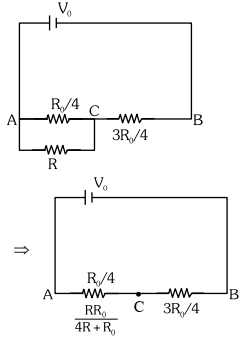
The sliding contact $C$ is at one fourth of the length of the potentiometer wire $( AB )$ from $A$ as shown in the circuit diagram. If the resistance of the wire $AB$ is $R _0$, then the potential drop $( V )$ across the resistor $R$ is
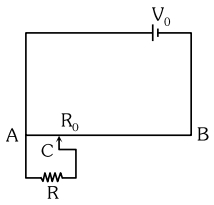
NEET 2022, Medium


Download our appand get started for free
Experience the future of education. Simply download our apps or reach out to us for more information. Let's shape the future of learning together!No signup needed.*
Similar Questions
- 1Two uniform wires $A$ and $B$ are of the same metal and have equal masses. The radius of wire $A$ is twice that of wire $B$. The total resistance of A and $B$ when connected in parallel isView Solution
- 2A certain wire has a resistance $R$. The resistance of another wire identical with the first except having twice its diameter isView Solution
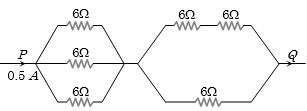
- 3Resistances of $6\, ohm$ each are connected in the manner shown in adjoining figure. With the current $0.5\,ampere$ as shown in figure, the potential difference ${V_P} - {V_Q}$ is .............. $V$View Solution
- 4Two wires '$A$' and '$B$' of the same material have their lengths in the ratio $1 : 2$ and radii in the ratio $2 : 1$. The two wires are connected in parallel across a battery. The ratio of the heat produced in '$A$' to the heat produced in '$B$' for the same time isView Solution
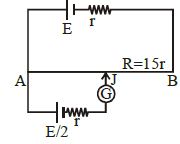
- 5The potentiometer wire $AB$ is $600\,\, cm$ long at what distance from $A$ should the Jockey $J$ touch the wire to get zero deflection in the galvanomenter ................ $\mathrm{cm}$View Solution
- 6What will happen when a $40\, watt$, $220\, volt$ lamp and $100\, watt$, $220\, volt$ lamp are connected in series across $40\, volt$ supplyView Solution
- 7In a neon discharge tube $2.9 \times {10^{18}}\,N{e^ + }$ ions move to the right each second while $1.2 \times {10^{18}}$ electrons move to the left per second. Electron charge is $1.6 \times {10^{ - 19}}\,C$. The current in the discharge tubeView Solution
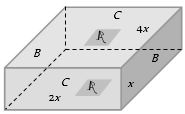
- 8In figure shows a rectangular block with dimensions $x,\, 2x$ and $4x$. Electrical contacts can be made to the block between opposite pairs of faces (for example, between the faces labelled $A-A, B-B$ and $C-C$). Between which two faces would the maximum electrical resistance be obtained ($A-A$ : Top and bottom faces, $B-B$ : Left and right faces, $C-C$ : Front and rear faces)View Solution
- 9$A$ current $I$ flows through a uniform wire of diameter $d$ when the mean electron drift velocity is $V$. The same current will flow through a wire of diameter $d/2$ made of the same material if the mean drift velocity of the electron is :View Solution
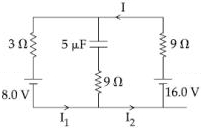
- 10The circuit shown here has two batteries of $8.0\,V$ and $16.0\,V$ and three resistors $3\,\Omega ,\,9\,\Omega $ and $9\,\Omega $ and a capacitor of $5.0\,\mu F.$View Solution
How much is the current $I$ in the circuit in steady state? ................... $A$