In a circuit shown in the figure, the capacitor $C$ is initially uncharged and the key $K$ is open. In this condition, a current of $1 \mathrm{~A}$ flows through the $1 \Omega$ resistor. The key is closed at time $t=t_0$. Which of the following statement($s$) is(are) correct?
[Given: $\mathrm{e}^{-1}=0.36$ ]
($A$) The value of the resistance $R$ is $3 \Omega$.
($B$) For $t$
($C$) At $t=t_0+7.2 \mu \mathrm{s}$, the current in the capacitor is $0.6 \mathrm{~A}$.
($D$) For $t \rightarrow \infty$, the charge on the capacitor is $12 \mu C$.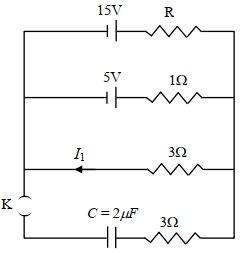
IIT 2023, Medium
Download our app for free and get started
(image)
By writing voltage drop across $1 \Omega$
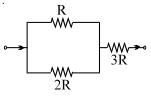
$\Rightarrow 0+5+1 \times 1=\mathrm{V}$
$\quad \mathrm{V}=6$
$\Rightarrow \text { Similarly across } \mathrm{R}$
$0+15-\mathrm{I} \times \mathrm{R}=6$
$\mathrm{IR}=9$
$\Rightarrow \text { across } 3 \Omega$
$\quad 6-3 \mathrm{I}_1=0$
$\mathrm{I}_1=2 \mathrm{~A}$
Hence option $(B)$ is correct
$\Rightarrow \quad \mathrm{I}=1+2$
$\mathrm{I}=3$
$\mathrm{IR}=9$
$\mathrm{R}=3 \Omega$
Option $(A)$ is correct
(image)
$\varepsilon=\frac{\frac{15}{3}+\frac{5}{1}+\frac{0}{3}}{\frac{1}{3}+\frac{1}{1}+\frac{1}{3}}=10 \times \frac{3}{5}=6 \mathrm{~V}$
$\mathrm{q}_{\max }=2 \times 6=12 \mu \mathrm{C}$
$\mathrm{i}=\frac{6}{3.6} \mathrm{e}^{-\frac{\mathrm{t}}{\tau}}$
$=\frac{5}{3} \mathrm{e}-\frac{7.2}{7.2}=\frac{5}{3} \mathrm{e}^{-1} \approx 0.6 \mathrm{~A}$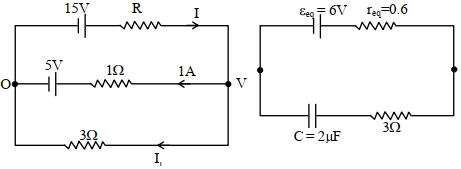

Download our appand get started for free
Experience the future of education. Simply download our apps or reach out to us for more information. Let's shape the future of learning together!No signup needed.*
Similar Questions
- 1When a resistance of $2\,ohm$ is connected across the terminals of a cell, the current is $0.5$ amperes. When the resistance is increased to $5\, ohm$, the current is $0.25\, amperes$. The internal resistance of the cell is ............. $ohm$View Solution
- 2The electric intensity $E$, current density $j$ and specific resistance $k$ are related to each other by the relationView Solution
- 3In a meter bridge experiment null point is obtained at $20\, cm$ from one end of the wire when resistance $X$ is balanced against another resistance $Y$. If $X < Y$, then where will be the new position of the null point from the same end, if one decides to balance a resistance of $4X$ against $Y$ ........... $cm$View Solution
- 4$A$ wire of cross-section area $A$, length $L_1$, resistivity $\rho_1$ and temperature coefficient of resistivity $\alpha_1$ is connected to a second wire of length $L_2$, resistivity $\rho_2$ , temperature coefficient of resistivity $\alpha_1$ and the same area $A$, so that wire carries same current. Total resistance $R$ is independent of temperature for small temperature change if (Thermal expansion effect is negligible)View Solution
- 5A platinum resistance thermometer has a resistance of $50\,\Omega $ at $20\,^o C$. When dipped in a liquid the resistance becomes $76.8\,\Omega $. The temperature coefficient of resistance for platinum is $\alpha = 3.92 \times {10^{ - 3}}\,^o C$. The temperature of the liquid is .............. $^o C$View Solution
- 6$A$ potentiometer wire has length $10\, m$ and resistance $10\,\Omega$ . It is connected to a battery of $EMF$ $11\, volt$ and internal resistance $1\, \Omega$ , then the potential gradient in the wire is ............... $V/m$View Solution
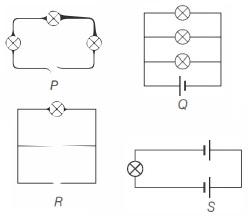
- 7Following figures show different combinations of identical bulb$(s)$ connected to identical battery$(ies)$. Which option is correct regarding the total power dissipated in the circuit?View Solution
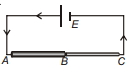
- 8In the following diagram, the lengths of wires $A B$ and $B C$ are equal, but the radius of wire $A B$ is double that of $B C$. The ratio of potential gradient on wires $A B$ and on $B C$ will be (wires are made of same material)View Solution
- 9Two resistances are joined in parallel whose resultant is $\frac{6}{8}\,ohm$. One of the resistance wire is broken and the effective resistance becomes $2\,\Omega $. Then the resistance in ohm of the wire that got broken wasView Solution
- 10The ratio of powers dissipatted respectively in $R$ and $3R$, as shown is:View Solution