MCQ
In a diatomic molecules, the rotational energy at a given temperature:
  • Obeys Maxwell’s distribution
  • B
    Have the same volue for all molecules
  • C
    Equals the translational kinetic energy for each molecule
  • D
    None of these

Answer

Correct option: A.
Obeys Maxwell’s distribution

Need a full question paper?

Generate a complete, print-ready paper with questions like this in minutes — across 16+ boards, with answer keys.
Start Generating Free

Similar questions

If the ratio of amplitude of wave is $2 : 1$, then the ratio of maximum and minimum intensity is
The X-ray beam emerging from an X-ray tube:
In an elastic collision:
  1. The kinetic energy remains constant.
  2. The linear momentum remains constant.
  3. The final kinetic energy is equal to the initial kinetic energy.
  4. The final linear momentum is equal to the initial linear momentum.
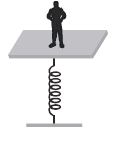
A man weighing $60\  kg$ stands on the horizontal platform of a spring balance. The platform starts executing simple harmonic motion of amplitude $0.1\  m$ and frequency $\frac{2}{\pi } Hz$. Which of the following staements is correct
The maximum percentage errors in the measurement of mass $(M)$, radius $(R)$ and angular velocity $(\omega)$ of a ring are $2 \%, 1 \%$ and $1 \%$ respectively, then find the maximum percentage error in the measurement of its angular momentum $(J=I \omega)$ about geometrical axis.
The rays of different colours fail to converge at a point after going through a converging lens. This defect is called:
Consider a particle of mass $m$ having linear momentum $\vec p$ at position $\vec r$ relative to the origin $O$ . Let $\vec L$ be the angular momentum of the particle with respect the origin. Which of the following equations correctly relate $(s)\, \vec r,\,\vec p$ and $\vec L$ ?
Two cars OF SAME LENGTH move in the same direction along parallel roads. One of them is a $100\ m$ long travelling with a velocity of $7.5\  ms^{−1}.$ How long will it take for the first car to overtake the second car?
Whose dimensions is $M{L^2}{T^{ - 1}}$
The maximum error in the measurement of resistance, current and time for which current flows in an electrical circuit are $1 \%, 2 \%$ and $3 \%$ respectively. The maximum percentage error in the detection of the dissipated heat will be