MCQ
Whose dimensions is $M{L^2}{T^{ - 1}}$
  • A
    Torque
  • Angular momentum
  • C
    Power
  • D
    Work

Answer

Correct option: B.
Angular momentum
b
(b) Angular momentum = $mvr = ML{T^{ - 1}} \times L = M{L^2}{T^{ - 1}}$

Need a full question paper?

Generate a complete, print-ready paper with questions like this in minutes — across 16+ boards, with answer keys.
Start Generating Free

Similar questions

A ring and a disc are initially at rest, side by side, at the top of an inclined plane which makes an angle $60^{\circ}$ with the horizontal. They start to roll without slipping at the same instant of time along the shortest path. If the time difference between their reaching the ground is $(2-\sqrt{3}) / \sqrt{10} \mathrm{~s}$, then the height of the top of the inclined plane, in metres, is. . . . . . Take $g=10 \mathrm{~m} \mathrm{~s}^{-2}$.
A body starts with an initial velocity of $10\,ms ^{-1}$ and is moving along a straight line with constant acceleration. When the velocity of the particle is $50\,ms ^{-1}$, the acceleration is reversed in direction. The velocity of the particle when it again reaches the starting point is $............\,m/s^{-1}$
A ball is dropped from height $10 \,m$. Ball is embedded in sand $1 \,m$ and stops, then
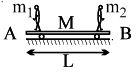
Two persons of mass $m_1$ and $m_2$ are standing at the two ends $A$ and $B $ respectively, of $a$ trolley of mass $M$ as shown. When only the person standing at $B$ jumps from the trolley towards right while the person at $A$ keeps standing, then
A circular hole of diameter $R$ is cut from a disc of mass $M$ and radius $R ;$ the circumference of the cut passes through the centre of the disc . The moment of inertia of the remaining portion of the disc about an axis perpendicular to the disc and passing through its centre is
A solid cylinder of radius $R$ and mass $M$, rolls down on inclined plane without slipping and reaches the bottom with a speed $v$. The speed would be less than $v$ if we use
In the equation $\left[X+\frac{a}{Y^2}\right][Y-b]= R T, X$ is pressure, $Y$ is volume, $R$ is universal gas constant and $T$ is temperature. The physical quantity equivalent to the ratio $\frac{a}{b}$ is
A scientist says that the efficiency of his heat engine which operates at source temperature $127°C$ and sink temperature $27°C$ is $26\%$, then
The gravitational force ${F_g}$ between two objects does not depend on
Two blocks of masses $10 \; kg$ and $30 \; kg$ are placed on the same straight line with coordinates $(0,0) \; cm$ and $( x , 0) \; cm$ respectively. The block of $10 \; kg$ is moved on the same line through a distance of $6 \; cm$ towards the other block. The distance through which the block of $30 \; kg$ must be moved to keep the position of centre of mass of the system unchanged is