Question
In a double slit interference experiment, the separation between the slits is 1.0mm, the wavelength of light used is 5.0 × 10⁻⁷m and the distance of the screen from the slits is 1.0m.
  1. Find the distance of the centre of the first minimum from the centre of the central maximum.
  2. How many bright fringes are formed in one centimeter width on the screen?
Answer

Given that, d = 1mm = 10-3m, D = 1m.
So, fringe with $=\frac{\text{D}\lambda}{\text{d}}=0.5\text{mm}.$
  1. So, distance of centre of first minimum from centre of central maximum $=\frac{0.5}{2}\text{mm}=0.25\text{mm}$
  2. No. of fringes $\frac{10}{0.5}=20.$

Need a full question paper?

Generate a complete, print-ready paper with questions like this in minutes — across 16+ boards, with answer keys.

Start Generating Free

Similar questions

Just as precise measurements are necessary in science, it is equally important to be able to make rough estimates of quantities using rudimentary ideas and common observations. Think of ways by which you can estimate the following (where an estimate is difficult to obtain, try to get an upper bound on the quantity):
The wind speed during a storm.
It is claimed that two cesium clocks, if allowed to run for 100 years, free from any disturbance, may differ by only about 0.02s. What does this imply for the accuracy of the standard cesium clock in measuring a time-interval of 1s?
What is the energy required for 1gm of ice to become steam?
The gravitational force exerted by the sun on the moon is greater than the force exerted by the Earth on the Moon. Even then why does the moon not migrate from Earth ?
What is the distance travelled by a point during the time, if it moves in x - y plane, according to the relation $\text{x}=\text{a}\sin\omega\text{t}$ and $\text{y}=\text{a}(1-\cos\omega\text{t})?$
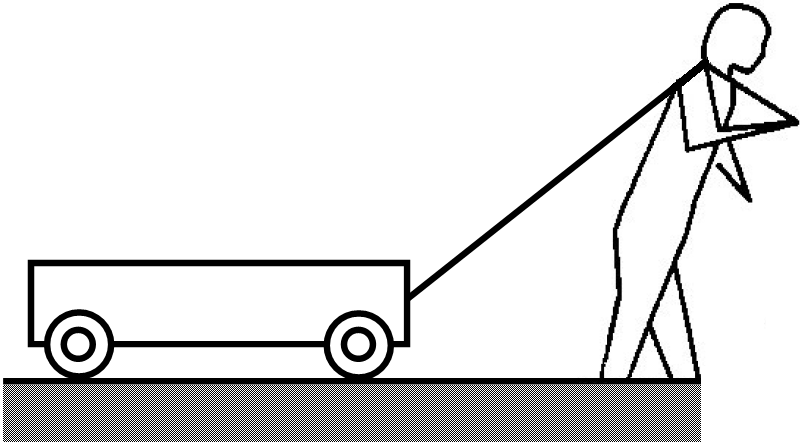
Figure shows a boy pulling a wagon on a road. List as many forces as you can which are relevant with this figure. Find the pairs of forces connected by Newton's third law of motion.

A body travels with a velocity v1 for time t1 and with a velocity v2 for time t2, find the average velocity of the body for the total time.
A particle moves from a point $\vec{\text{r}}_1=(2\text{m})\vec{\text{i}}+(3\text{m})\vec{\text{j}}$ to another point $\vec{\text{r}}_2=(3\text{m})\vec{\text{i}}+(2\text{m})\vec{\text{j}}$ during which a certain force $\vec{\text{F}}=(5\text{N})\vec{\text{i}}+(5\text{N})\vec{\text{j}}$ acts on it. Find the work done by the force on the particle during the displacement.
The radius of a solid sphere is measured to be 11.24cm. What is the surface area of the sphere to appropriate significant figures?
Find the dimensions of:

  1. Angular speed $\omega.$
  2. Angular acceleration $\alpha.$
  3. Torque $\tau$ and
  4. Moment of interia I.
Some of the equations involving these quantities are

$\omega=\frac{\theta_2-\theta_1}{\text{t}_2-\text{t}_1},\alpha=\frac{\omega_2-\omega_1}{\text{t}_2-\text{t}_1},\tau=\text{F.r}$ and $\text{I = mr}^2.$

The symbols have standard meanings.