Questions

2 Marks Questions

Take a timed test

25 questions · self-marked practice — reveal the answer and mark yourself.

Question 12 Marks
A source emitting light of wavelengths 480nm and 600nm is used in. a double slit interference experiment. The separation between the slits is 0.25mm and the interference is observed on a screen placed at 150cm from the slits. Find the linear separation between the first maximum (next to the central maximum) corresponding to the two wavelengths.
Answer
We know that, the first maximum (next to central maximum) occurs at $\text{y}=\frac{\lambda\text{D}}{\text{d}}$

Given that, $\lambda_1=480\text{nm},\lambda_2=600\text{nm},$ D = 150cm = 1.5m and d = 0.25mm = 0.25 × 10⁻³m

So, $\text{y}_1=\frac{\text{D}\lambda_1}{\text{d}}=\frac{1.5\times480\times10^{-9}}{0.25\times10^{-3}}=2.88\text{mm}$

$\text{y}_2=\frac{1.5\times600\times10^{-9}}{0.25\times10^{-3}}=3.6\text{mm}.$

So, the separation between these two bright fringes is given by,

$\therefore$ separation = y2 - y1 = 3.60 - 2.88 = 0.72mm.
View full question & answer
Question 22 Marks
The speed of the yellow light in a certain liquid is 2.4 × 10⁸m/s. Find the refractive index of the liquid.
Answer
$\mu_\text{t}=\frac{1\times3\times10^8}{(2.4)\times10^8}=1.25$ $\Big[\text{since}, \mu=\frac{\text{velocity of light in vaccum}}{\text{velocity of light in the given medium}}\Big]$
View full question & answer
Question 32 Marks
A plate of thickness t made of a material of refractive index $\mu$ is placed in front of one of the slits in a double slit experiment.
  1. Find the change in the optical path due to introduction of the plate.
  2. What should be the minimum thickness t which will make the intensity at the centre of the fringe pattern zero? Wavelength of the light used is $\lambda$. Neglect any absorption of light in the plate.
Answer
  1. Change in the optical path $=\mu\text{t}-\text{t}=(\mu-1)\text{t}$
  2. To have a dark fringe at the centre the pattern should shift by one half of a fringe.

$\Rightarrow(\mu-1)\text{t}=\frac{\lambda}{2}\Rightarrow\text{t}=\frac{\lambda}{2(\mu-1)}$

View full question & answer
Question 42 Marks
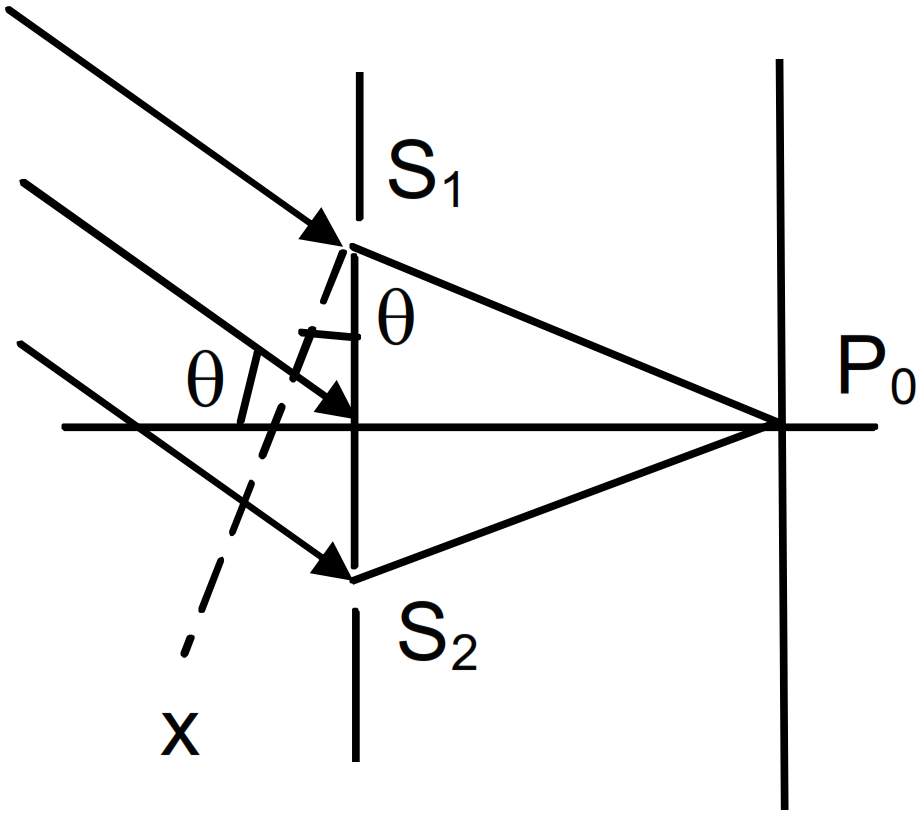
A parallel beam of monochromatic light is used in a Young's double slit experiment. The slits are separated by a distance d and the screen is placed parallel to the plane of the slits. Show that if the incident beam makes an angle $\theta=\sin^{-1}\Big(\frac{\lambda}{2\text{D}}\Big)$ with the normal to the plane of the slits, there will be a dark fringe at the centre P0 of the pattern.
Answer

It can be seen from the figure that the wavefronts reaching O from S1 and S2 will have a path difference of S2X.

In the $\Delta\text{S}_1\text{S}_2\text{X},$

$\sin\theta=\frac{\text{S}_2\text{X}}{\text{S}_1\text{S}_2}$

So, path difference $=\text{S}_2\text{X}=\text{S}_1\text{S}_2\sin\theta=\text{d}\sin\theta=\text{d}\times\frac{\lambda}{2\text{d}}=\frac{\lambda}{2}$

As the path difference is an odd multiple of $\frac{\lambda}{2},$ there will be a dark fringe at point P0.

View full question & answer
Question 52 Marks
A convex lens of diameter 8.0cm is used to focus a parallel beam of light of wavelength 620nm. If the light be focused at a distance of 20cm from the lens, what would be the radius of the central bright spot formed?
Answer
$\lambda=620\text{nm}=620\times10^{-9}\text{m},$

$\text{D}=20\text{cm}=20\times10^{-2}\text{m},\text{b}=8\text{cm}=8\times10^{-2}\text{m}$

$\therefore\text{R}=1.22\times\frac{620\times10^{-4}\times20\times10^{-2}}{8\times10^{-2}}$ $=1891\times10^{-9}=1.9\times10^{-6}\text{m}$

So, diameter $=2\text{R}=3.8\times10^{-6}\text{m}$

View full question & answer
Question 62 Marks
Light of wavelength 560nm goes through a pinhole of diameter 0.20mm and falls on a wall at a distance of 2.00m. What will be the radius of the central bright spot formed on the wall?
Answer
$\lambda=560\text{nm}=560\times10^{-9}\text{m},$ $\text{b}=0.20\text{mm}=2\times10^{-4}\text{m},\text{D}=2\text{m}$

Since, $\text{R}=1.22\frac{\lambda\text{D}}{\text{b}}=1.22\times\frac{560\times10^{-9}\times2}{2\times10^{-4}}$ $=6.832\times10^{-3}\text{M}=0.683\text{cm}.$

So, diameter $=2\text{R}=1.37\text{cm}.$

View full question & answer
Question 72 Marks
White light is used in a Young's double slit experiment. Find the minimum order of the violet fringe $(\lambda=400\text{nm}),$ which overlaps with a red fringe $(\lambda=700\text{nm}).$
Answer
Let mth bright fringe of violet light overlaps with nth bright fringe of red light.

$\therefore\frac{\text{m}\times400\text{nm}\times\text{D}}{\text{d}}=\frac{\text{n}\times700\text{nm}\times\text{D}}{\text{d}}\Rightarrow\frac{\text{m}}{\text{n}}=\frac{7}{4}$

⇒ 7th bright fringe of violet light overlaps with 4th bright fringe of red light (minimum). Also, it can be seen that 14th violet fringe will overlap 8th red fringe.

Because, $\frac{\text{m}}{\text{n}}=\frac{7}{4}=\frac{14}{8}$

View full question & answer
Question 82 Marks
The linewidth of a bright fringe is sometimes defined as the separation between the points on the two sides of the central line where the intensity falls to half the maximum. Find the linewidth of a bright fringe in a Young's double slit experiment in terms of $\lambda$, d and D where the symbols have their usual meanings.
Answer
The line width of a bright fringe is sometimes defined as the separation between the points on the two sides of the central line where the intensity falls to half the maximum.

We know that, for intensity to be half the maximum,

$\text{y}=\pm\frac{\lambda}{4\text{d}}$

$\therefore$ Line width $=\frac{\lambda\text{D}}{4\text{d}}+\frac{\lambda\text{D}}{4\text{d}}=\frac{\lambda\text{D}}{2\text{d}}.$

View full question & answer
Question 92 Marks
Two transparent slabs having equal thickness but different refractive indices $\mu_1$ and $\mu_2$ are pasted side by side to form a composite slab. This slab is placed just after the double slit in a Young's experiment so that the light from one slit goes through one material and the light from the other slit goes through the other material. What should be the minimum thickness of the slab so that there is a minimum at the point P0 which is equidistant from the slits?
Answer
The change in path difference due to the two slabs is $(\mu_1-\mu_2)\text{t}$ (as in problem no. 16).
For having a minimum at P0, the path difference should change by $\frac{\lambda}{2}.$
So, $\Rightarrow\frac{\lambda}{2}=(\mu_1-\mu_2)\text{t}\Rightarrow\text{t}=\frac{\lambda}{2(\mu_1-\mu_2)}.$
View full question & answer
Question 102 Marks
A Young's double slit apparatus has slits separated by 0.28mm and a screen 48cm away from the slits. The whole apparatus is immersed in water and the slits are illuminated by the red light ($\lambda=700\text{nm}$ in vacuum). Find the fringe-width of the pattern formed on the screen.
Answer
Given that, d = 0.28mm = 0.28 × 10⁻³m, D = 48cm = 0.48m, $\lambda_\text{a}=700\text{nm}$ in vacuum

Let, $\lambda_\text{w}$ = wavelength of red light in water

Since, the fringe width of the pattern is given by,

$\beta=\frac{\lambda_\text{w}\text{D}}{\text{d}}$

$=\frac{525\times10^{-9}\times0.48}{0.28\times10^{-3}}=9\times10^{-4}\text{m}=0.90\text{mm}.$

View full question & answer
Question 112 Marks
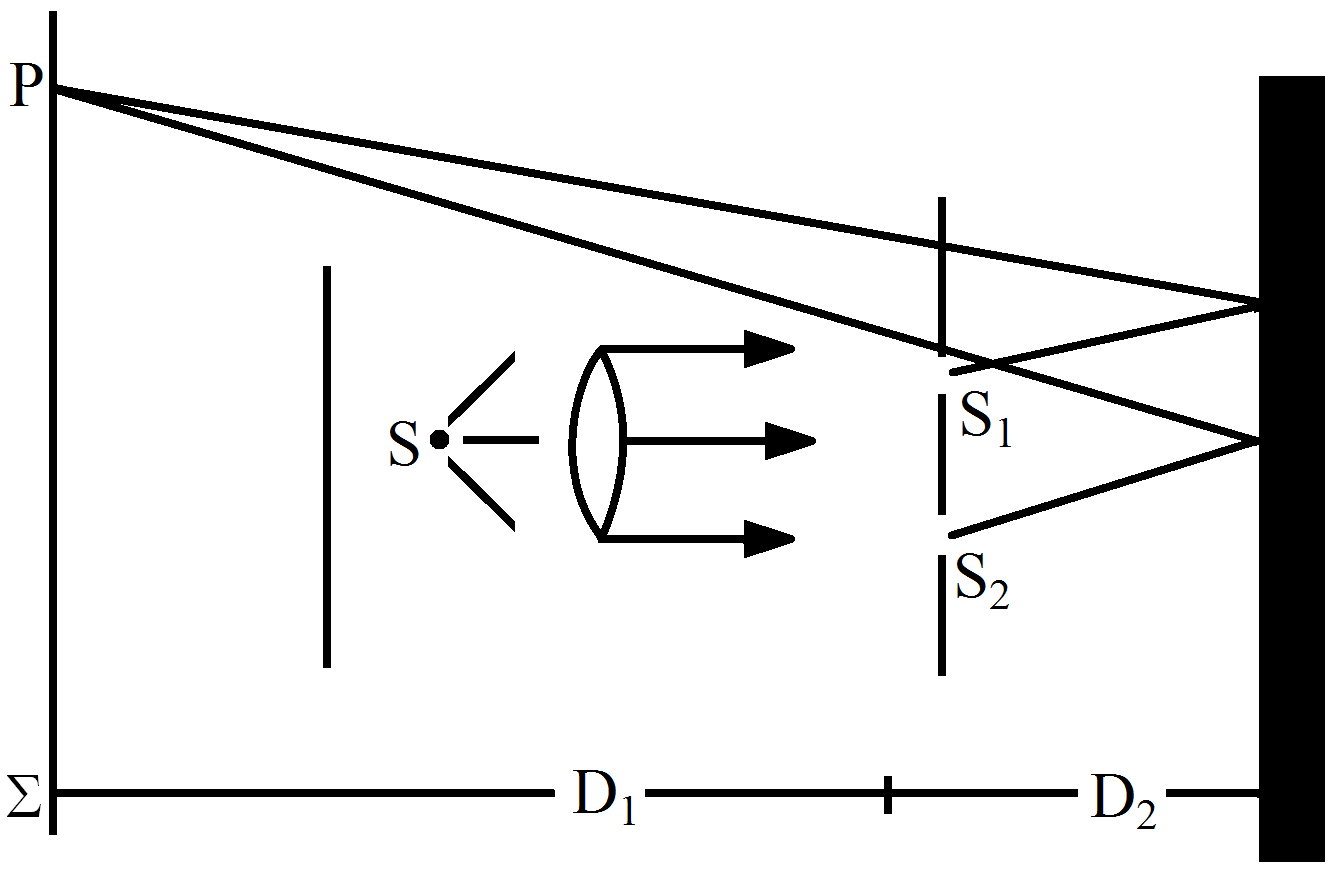
A double slit S1 - S2 is illuminated by a coherent light of wavelength $\lambda$. The slits are separated by a distance d. A plane mirror is placed in front of the double slit at a distance D1 from it and a screen $\sum$ is placed behind the double slit at a distance D2 from it (figure 17-E2). The screen E receives only the light reflected by the mirror. Find the fringe-width of the interference pattern on the screen.

Answer
It can be seen from the figure that, the apparent distance of the screen from the slits is,
D = 2D1 + D2
So, Fringe width $=\frac{\text{D}\lambda}{\text{d}}=\frac{(2\text{D}_1+\text{D}_2)\lambda}{\text{d}}$
View full question & answer
Question 122 Marks
Can we conclude from the interference phenomenon whether light is a transverse wave or a longitudinal wave?
Answer
The interference pattern can be produced by any two coherent waves moving in the same direction. It cannot be concluded from the interference phenomenon that light is a transverse wave, as sound waves that are longitudinal in nature also interfere.
View full question & answer
Question 132 Marks
The wavelength of light in a medium is $\lambda=\frac{\lambda_0}{\mu},$ where $\lambda$ is the wavelength in vacuum. A beam of red light $(\lambda_0=720\text{nm})$ enters into water. The wavelength in water is $\lambda=\frac{\lambda_0}{\mu}=540\text{nm}.$ To a person under water does this light appear green?
Answer
Colour of light will depend only on the frequency of light and not on the wavelength of the light. So, light will appear red to an observer under water.
View full question & answer
Question 142 Marks
Whether the diffraction effects from a slit will be more clearly visible or less clearly, if the slit-width is increased?
Answer
The width of the central band is inversely proportional to the slit Width. So, as the width of the slit is increased, the central band will become less wider and further bands will start merging in them. Hence, diffraction effects will be visible less clearly.
View full question & answer
Question 152 Marks
If we put a cardboard (say 20cm × 20cm) between a light source and our eyes, we can't see the light. But when we put the same cardboard between a sound source and our ear, we hear the sound almost clearly. Explain.
Answer
Light waves have the property of travelling in a straight line, unlike sound waves. When we put a cardboard between the light source and our eyes, the light waves are obstructed by the cardboard and cannot reach our eyes, which doesn't happen when the cardboard is inserted between sound source and our ear.
View full question & answer
Question 162 Marks
A parallel beam of light of wavelength 560nm falls on a thin film of oil (refractive index = 1.4). What should be the minimum thickness of the film so that it strongly reflects the light?
Answer
Given that, $\lambda=560\times10^{-9}\text{m},\mu=1.4.$

For strong reflection, $2\mu\text{d}=(2\text{n}+1)\frac{\lambda}{2}\Rightarrow\text{d}=\frac{(2\text{n}+1)\lambda}{4\text{d}}$

For minimum thickness, putting n = 0.

$\Rightarrow\text{d}=\frac{\lambda}{4\text{d}}\Rightarrow\text{d}=\frac{560\times10^{-9}}{14}=10^{-7}\text{m}=100\text{nm}.$

View full question & answer
Question 172 Marks
Find the angular separation between the consecutive bright fringes in a Young's double slit experiment with blue-green light of wavelength 500nm. The separation between the slits is 2.0 × 10⁻³m.
Answer
Given that, $\lambda=500\text{nm}=500\times10^{-9}\text{m}$ and d = 2 × 10⁻³m

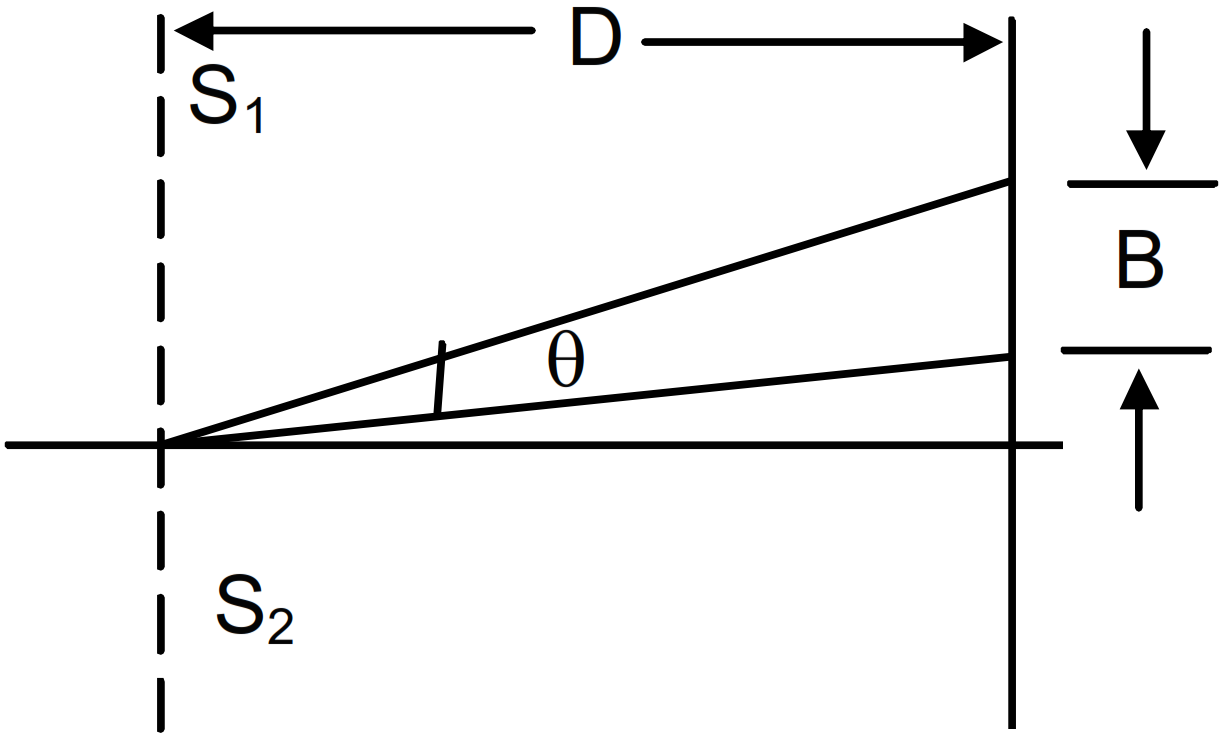
As shown in the figure, angular separation $\theta=\frac{\beta}{\text{D}}=\frac{\lambda\text{D}}{\text{dD}}=\frac{\lambda}{\text{d}}$
So, $\theta=\frac{\beta}{\text{D}}=\frac{\lambda}{\text{d}}=\frac{500\times10^{-9}}{2\times10^{-3}}=250\times10^{-6}$
= 25 × 10-5 radian = 0.014 degree.
View full question & answer
Question 182 Marks
In a double slit interference experiment, the separation between the slits is 1.0mm, the wavelength of light used is 5.0 × 10⁻⁷m and the distance of the screen from the slits is 1.0m.
  1. Find the distance of the centre of the first minimum from the centre of the central maximum.
  2. How many bright fringes are formed in one centimeter width on the screen?
Answer
Given that, d = 1mm = 10-3m, D = 1m.
So, fringe with $=\frac{\text{D}\lambda}{\text{d}}=0.5\text{mm}.$
  1. So, distance of centre of first minimum from centre of central maximum $=\frac{0.5}{2}\text{mm}=0.25\text{mm}$
  2. No. of fringes $\frac{10}{0.5}=20.$
View full question & answer
Question 192 Marks
A transparent paper (refractive index = 1.45) of thickness 0.02mm is pasted on one of the slits of a Young's double slit experiment which uses monochromatic light of wavelength 620nm. How many fringes will cross through the centre if the paper is removed?
Answer
Given that, $\mu=1.45,$ t = 0.02mm = 0.02 × 10⁻³m and $\lambda=620\text{nm}=620\times10^{-9}\text{m}$

We know, when the transparent paper is pasted in one of the slits, the optical path changes by $(\mu-1)\text{t}.$

Again, for shift of one fringe, the optical path should be changed by $\lambda.$

So, no. of fringes crossing through the centre is given by,

$\text{n}=\frac{(\mu-1)\text{t}}{\lambda}=\frac{0.45\times0.02\times10^{-3}}{620\times10^{-9}}=14.5$

View full question & answer
Question 202 Marks
In a Young's double slit experiment, two narrow vertical slits placed 0.800mm apart are illuminated by the same source of yellow light of wavelength 589nm. How far are the adjacent bright bands in the interference pattern observed on a screen 2.00m away?
Answer
Given that, $\text{d} = 0.8\text{mm} = 0.8 × 10^{-3}\text{m},$ $\lambda=589\text{nm}=589\times10^{-9}\text{m}\text{ and D}=2\text{m}.$ 
So, $\beta=\frac{\text{D}\lambda}{\text{d}}=\frac{589\times10^{-9}\times2}{0.8\times10^{-3}}=1.47\times10^{-3}=147\text{mm}.$
View full question & answer
Question 212 Marks
The separation between the consecutive dark fringes in a Young's double slit experiment is 1.0mm. The screen is placed at a distance of 2.5m from the slits and the separation between the slits is 1.0mm. Calculate the wavelength of light used for the experiment.
Answer
Given that, $\beta=1\text{mm}=10^{-3}\text{m},$ D = 2.5m and d = 1mm = 10-3m
So, $10^{-3}\text{m}=\frac{25\times\lambda}{10^{-3}}\Rightarrow\lambda=4\times10^{-7}\text{m}=400\text{nm}.$
View full question & answer
Question 222 Marks
A soap film of thickness 0.0011mm appears dark when seen by the reflected light of wavelength 580nm. What is the index of refraction of the soap solution, if it is known to be between 1.2 and 1.5?
Answer
Given, $\text{d}=0.0011\times10^{-3}\text{m}$

For minimum reflection of light, $2\mu\text{d}=\text{n}\lambda$

$\Rightarrow\mu=\frac{\text{n}\lambda}{2\text{d}}=\frac{2\text{n}\lambda}{4\text{d}}=\frac{580\times10^{-9}\times2\text{n}}{4\times11\times10^{-7}}$ $=\frac{5.8}{44}(2\text{n})=0.132(2\text{n})$

Given that, $\mu$ has a value in between 1.2 and 1.5.

⇒ When, $\text{n}=5,\mu=0.132\times10=1.32.$

View full question & answer
Question 232 Marks
A long narrow horizontal slit is placed 1mm above a horizontal plane mirror. The interference between the light coming directly from the slit and that after reflection is seen on a screen 1.0m away from the slit. Find the fringe-width if the light used has a wavelength of 700nm.
Answer
Given that, D = 1m, $\lambda=700\text{nm}=700\times10^{-9}\text{m}$
Since, a = 2mm, d = 2a = 2mm = 2 × 10⁻³m (L loyd’s mirror experiment)
Fringe width $=\frac{\lambda\text{D}}{\text{d}}=\frac{700\times10^{-9}\text{m}\times1\text{m}}{2\times10^{-3}\text{m}}=0.35\text{mm}.$
View full question & answer
Question 242 Marks
In a Young's double slit experiment $\lambda=500\text{nm},$ d = 1.0mm and D = 1.0m. Find the minimum distance from the central maximum for which the intensity is half of the maximum intensity.
Answer
Given that, D = 1m, d = 1mm = 10-3m, $\lambda=500\text{nm}=5\times10^{-7}\text{m}$

For intensity to be half the maximum intensity.

$\text{y}=\frac{\lambda\text{D}}{4\text{d}}$

$\Rightarrow\text{y}=\frac{5\times10^{-7}\times1}{4\times10^{-3}}\Rightarrow\text{y}=1.25\times10^{-4}\text{m}.$

View full question & answer
Question 252 Marks
Is it necessary to have two waves of equal intensity to study interference pattern? Will there be an effect on clarity if the waves have unequal intensity?
Answer
Interference pattern can be studied with waves of unequal intensity.

$\text{I}=\text{I}_1+\text{I}_2+2\sqrt{[\text{I}_1\times\text{I}_2]}\cos(\phi),$

Where $\phi$, = phase difference.

In case of waves of unequal intensities, the contrast will not be clear, as the minima will not be completely dark.

View full question & answer
2 Marks Questions - Physics STD 11 Science Questions - Vidyadip