Question
In a library, 25 students read physics, chemistry and mathematics books. It was found that 15 students read mathematics, 12 students read physics while 11 students read chemistry. 5 students read both mathematics and chemistry, 9 students read physics and mathematics. 4 students read physics and chemistry and 3 students read all three subject books.
Based on the above information, answer the following questions.

  1. The number of students who reading only chemistry is:
  1. 5
  2. 4
  3. 2
  4. 1
  1. The number of students who reading only mathematics is:
  1. 4
  2. 3
  3. 5
  4. 11
  1. The number of students who reading only one of the subjects is:
  1. 5
  2. 11
  3. 8
  4. 6
  1. The number of students who reading atleast one of the subject is:
  1. 20
  2. 22
  3. 23
  4. 21
  1. The number of students who reading none of the subject is:
  1. 2
  2. 4
  3. 3
  4. 5

Answer

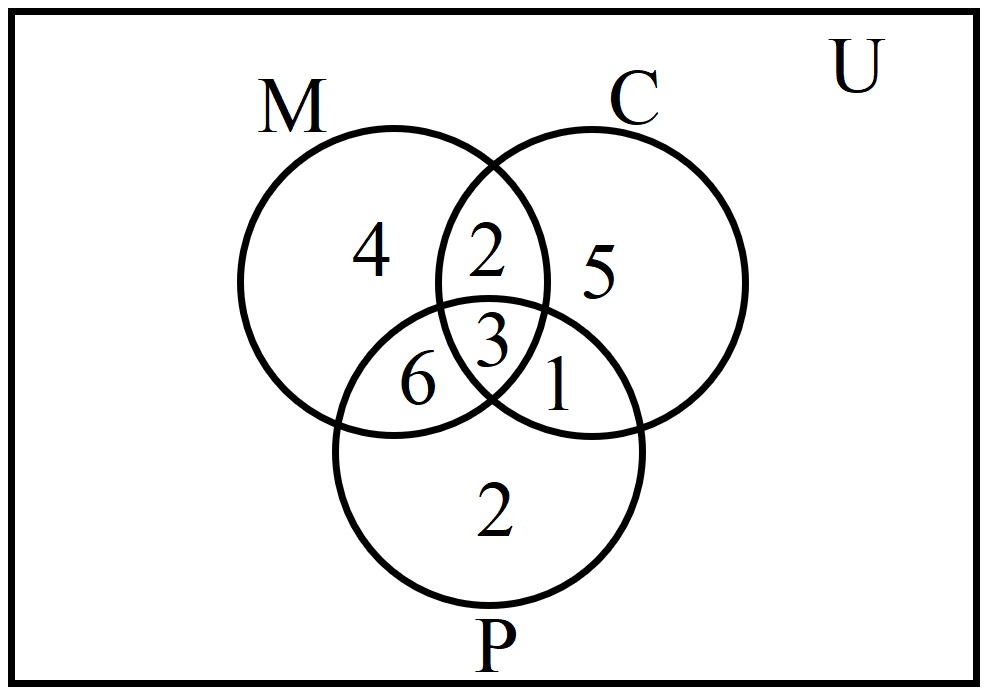
Let M denotes set of student who reading mathematics books, P denotes who reading Physics books and C denotes who reading chemistry books.

we have,

$\text{n}(\text{U})=25,\text{n}(\text{M})=15,\text{n}(\text{P})=12,\text{n}(\text{C})=11,$ $\text{n}(\text{M}\cap\text{C})=5,\text{n}(\text{M}\cap\text{P})=9,\text{n}(\text{P}\cap\text{C})=4,\text{n}(\text{M}\cap\text{P}\cap\text{C})=3$

  1. (a) 5

Solution:

The number of students who reading only Chemistry is 5.

  1. (a) 4

Solution:

The number of students who reading only Mathematics is 4.

  1. (c) 8

Solution:

The number of students who reading only one of the subject is 4 + 5 + 2 i.e. 11.

  1. (c) 23

Solution:

The number of students who reading atleast one of the subject is 4 + 6 + 3 + 2 + 5 + 1 + 2 i.e. 23.

  1. (a) 2

Solution:

The number of students who reading none of the subject is 25 - 23 i.e. 2.

Need a full question paper?

Generate a complete, print-ready paper with questions like this in minutes — across 16+ boards, with answer keys.

Start Generating Free

Similar questions

The school organised a cultural event for 100 students. In the event, 15 students participated in dance, drama and singing. 25 students participated in dance and drama; 20 students participated in drama and singing; 30 students participated in dance and singing. 8 students participated in dance only; 5 students in drama only and 12 students in singing only.

Based on the above information, answer the following questions.
  1. The number of students who participated in dance, is:
  1. 18
  2. 30
  3. 40
  4. 48
  1. The number of students who participated in drama, is:
  1. 35
  2. 30
  3. 25
  4. 20
  1. The number of students who participated in singing, is:
  1. 42
  2. 45
  3. 47
  4. 37
  1. The number of students who participated in dance and drama but not in singing, is:
  1. 20
  2. 5
  3. 10
  4. 15
  1. The number of students who did not participate in any of the events, is:
  1. 20
  2. 30
  3. 25
  4. 35
Shweta was teaching "method to solve a linear inequality in one variable" to her daughter.
Step I Collect all terms involving the variable (x) on one side and constant terms on other side with the help of above rules and then reduce it in the form $\mathbf{a x}<\mathbf{b}$ or $\mathbf{a x} \leq \mathbf{b}$ or $\mathbf{a x}>\mathbf{b}$ or $\mathbf{a x} \geq \mathbf{b}$.
Step II Divide this inequality by the coefficient of variable (x). This gives the solution set of given inequality.
Step III Write the solution set.

Based on above information, answer the following questions.

(i) The solution set of $\mathbf{2 4 x}<\mathbf{1 0 0}$, when $\mathrm{x}$ is a natural number is
    (a) $\{1,2,3,4\}$     (b) $(1,4)$     (c) $[1,4]$     (d) None of these

(ii) The solution set of $24100 \mathrm{x}<$, when $\mathrm{x}$ is an integer is
    (a) $\{\ldots \ldots-4,-3,-2,-1,0,1,2,3,4\}$     (b) $(-\infty, 4]$     (c) $[4, \infty]$     (d) None of the above

(iii) The solution set of $-\mathbf{5 x}+\mathbf{2 5}>0$ is
    (a) $[5, \infty)$     (b) $(-\infty, 5]$    (c) $(5, \infty)$     (d) $(-\infty, 5)$

(iv) The solution set of $\mathbf{3 x}-\mathbf{5}<\mathbf{x + 7}$ is
    (a) $(6, \infty)$     (b) $[6, \infty)$     (c) $(-\infty, 6)$     (d) $(-\infty, 6]$

(v) The solution set of $x+\frac{x}{2}+\frac{x}{3}<11$ is
    (a) $(-\infty, 6]$     (b) $(-\infty, 6)$     (c) $[6, \infty)$     (d) None of these
A function $f$ is said to be a rational function, if $f(x)=\frac{g(x)}{h(x)}$, where $g(x)$ and $h(x)$ are polynomial functions such that $h(x) \neq 0$.
Then, $\lim _{x \rightarrow a} f(x)=\lim _{x \rightarrow a} \frac{g(x)}{h(x)}$
$
=\frac{\lim _{x \rightarrow a} g(x)}{\lim _{x \rightarrow a} h(x)}=\frac{g(a)}{h(a)}
$
However, if $h(a)=0$, then there are two cases arise,
(i) $g(a) \neq 0$
(ii) $g(a)=0$. In the first case, we say that the limit does not exist.
In the second case, we can find limit.

Based on above information, answer the following questions.

(i) $\lim _{x \rightarrow-1}\left(\frac{x^{10}+x^5+1}{x-1}\right)$ is equal to
    (a) $\frac{1}{2}$     (b) $\frac{-1}{2}$     (c) 2     (d) $\frac{3}{2}$

(ii) $\lim _{x \rightarrow-1} \frac{(x-1)^2+3 x^2}{\left(x^4+1\right)^2}$ is equal to
    (a) $\frac{7}{4}$     (b) $\frac{6}{5}$     (c) $\frac{4}{7}$     (d) $\frac{3}{4}$

(iii) The value of $\lim _{x \rightarrow 2}\left[\frac{x^2-4}{x^3-4 x^2+4 x}\right]$ is
    (a) 0     (b) 1     (c) 2     (d) Does not exist

(iv) $\lim _{x \rightarrow 1} \frac{x^7-2 x^5+1}{x^3-3 x^2+2}$ is equal to
    (a) 0     (b) 1     (c) 2     (d) 3

(v) $\lim _{x \rightarrow 0} \frac{\sqrt{1+x^3}-\sqrt{1-x^3}}{x^2}$ is equal to
    (a) 1     (b) 0     (c) -1     (d) 2
Rajiv constructs two right angled triangles in the fourth quadrant in such a way that the measure of triangle gives $\cos A=\frac{4}{5}$ and $\cos B=\frac{12}{13}$, where $\frac{3 \pi}{2} < A$ and $B > 2 \pi$.
Image
Based on the above information, answer the following questions.
(i) Find the value of $\cos (A+B)$
(ii) Find the value of $\sin (A-B)$
(iii) Find the value of $\tan (\mathbf{A}+\mathbf{B})$