In a parallel plate condenser, the radius of each circular plate is $12\,cm$ and the distance between the plates is $5\,mm$. There is a glass slab of $3\,mm$ thick and of radius $12\,cm$ with dielectric constant $6$ between its plates. The capacity of the condenser will be
Medium
Download our app for free and get started
(c) $C = \frac{{{\varepsilon _0}A}}{{d - t + \frac{t}{K}}} = \frac{1}{{4\pi \times 9 \times {{10}^9}}}.\frac{{\pi \,{{(0.12)}^2}}}{{\left( {2 + \frac{1}{2}} \right)\,{{10}^{ - 3}}}}$
$ = \frac{{2 \times 144 \times {{10}^{ - 10}}}}{{36 \times 5}} = 160\,pF$
$ = \frac{{2 \times 144 \times {{10}^{ - 10}}}}{{36 \times 5}} = 160\,pF$

Download our appand get started for free
Experience the future of education. Simply download our apps or reach out to us for more information. Let's shape the future of learning together!No signup needed.*
Similar Questions
- 1View SolutionA capacitor is charged by a battery. The battery is removed and another identical uncharged capacitor is connected in parallel. The total electrostatic energy of resulting system
- 2A particle of charge $Q$ and mass $M$ moves in a circular path of radius $R$ in a uniform magnetic field of magnitude $B$. The same particle now moves with the same speed in a circular path of same radius $R$ in the space between the cylindrical electrodes of the cylindrical capacitor. The radius of the inner electrode is $R/2$ while that of the outer electrode is $ 3R/2.$ Then the potential difference between the capacitor electrodes must beView Solution
- 3The capacity of a parallel plate condenser is $10\,\mu \,F$, when the distance between its plates is $8 \,cm$. If the distance between the plates is reduced to $4\, cm$, then the capacity of this parallel plate condenser will be.........$\mu \,F$View Solution
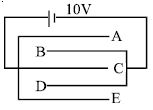
- 4Five identical capacitor plates are arranged such that they make capacitors each of $2\ \mu F$. The plates are connected to a source of $emf$ $10\ V$. The charge on plate $C$ is......$ \mu C$View Solution
- 5A parallel plate capacitor has plate area $A$ and separation $d$. It is charged to a potential difference $V_o$. The charging battery is disconnected and the plates are pulled apart to three times the initial separation. The work required to separate the plates isView Solution
- 6View SolutionConsider a finite insulated, uncharged conductor placed near a finite positively charged conductor. The uncharged body must have a potential
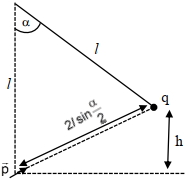
- 7A point charge $q$ of mass $m$ is suspended vertically by a string of length $l$. A point dipole of dipole moment $\overrightarrow{ p }$ is now brought towards $q$ from infinity so that the charge moves away. The final equilibrium position of the system including the direction of the dipole, the angles and distances is shown in the figure below. If the work done in bringing the dipole to this position is $N \times( mgh )$, where $g$ is the acceleration due to gravity, then the value of $N$ is. . . . . . (Note that for three coplanar forces keeping a point mass in equilibrium, $\frac{F}{\sin \theta}$ is the same for all forces, where $F$ is any one of the forces and $\theta$ is the angle between the other two forces)View Solution
- 8Two metal spheres of radii ${R_1}$ and ${R_2}$ are charged to the same potential. The ratio of charges on the spheres isView Solution
- 9Two spherical conductors $A$ and $B$ of radii $1\ mm$ and $2\ mm$ are separated by a distance of $5\ cm$ and are uniformly charged. If the spheres are connected by a conducting wire then in equilibrium condition, the ratio of the magnitude of the electric fields at the surfaces of spheres $A$ and $B$ isView Solution
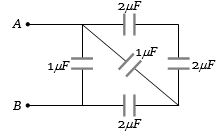
- 10The total capacity of the system of capacitors shown in the adjoining figure between the points $A$ and $B$ is.....$\mu F$View Solution