Question
In a purely inductive circuit, the current:

Answer

  1. lags behind the voltage by $\frac{\pi}{2}$
Explanation:
In a purely inductive circuit (an AC circuit containing inductance only) the current lags behind the voltage by $\frac{\pi}{2}$

Need a full question paper?

Generate a complete, print-ready paper with questions like this in minutes — across 16+ boards, with answer keys.
Start Generating Free

Similar questions

Energy of a charged conductor is :
While a capacitor remains connected to a battery and dielectric slab is applied between the plates, then(a) Potential difference between the plates is changed(b) Charge flows from the battery to the capacitor(c) Electric field between the plates increases(d) Energy store in the capacitor decreases
   
   
Current provided by a battery is maximum when(a) Internal resistance equal to external resistance(b) Internal resistance is greater than external resistance(c) Internal resistance is less than external resistance(d) None of these


The photo-electrons emitted from a surface of sodium metal are such that         (a) They all are of the same frequency(b) They have the same kinetic energy(c) They have the same de Broglie wavelength(d) They have their speeds varying from zero to a certain maximum


Assertion :   Charge is quantized
Reason    : Charge, which is less than 1 C is not possible(a) If both assertion and reason are true and the reason is the correct explanation of the assertion.(b) If both assertion and reason are true but reason is not the correct explanation of the assertion.(c) If assertion is true but reason is false.(d) If the assertion and reason both are false.


Two charges of $10C$ and $-15C$ are separated in air by $1m.$The ratio of force exerted by one on the other is:
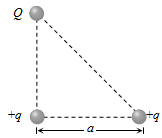
Three charges $Q, +q$ and $+q$ are placed at the vertices of a right$-$angled isosceles triangle as shown. The net electrostatic energy of the configuration is zero if $Q$ is equal to
The activity of a radioactive sample is measured as 9750 counts per minute at t = 0 and as 975 counts per minute at t = 5 minutes. The decay constant is approximately(a) 0.230 per minute(b) 0.461 per minute(c) 0.691 per minute(d) 0.922 per minute
   
   
With a potentiometer null point were obtained at 140 cm and 180 cm with cells of emf 1.1 V and one unknown X volts. Unknown emf is(a) 1.1 V(b) 1.8 V(c) 2.4 V  (d) 1.41 V
       
A bulb has specification of one kilowatt and $250$ volts, the resistance of bulb is