In a Resonance -Coulmn lab experiment to measure the velocity of sound, the first resonance is obtained at a length $l_1$ and the second resonance at a length $l_2$. Then-
Medium


Download our appand get started for free
Experience the future of education. Simply download our apps or reach out to us for more information. Let's shape the future of learning together!No signup needed.*
Similar Questions
- 1In an experiment to determine the velocity of sound in air at room temperature using a resonance is observed when the air column has a length of $20.0 \,cm$ for a tuning fork of frequency $400 \,Hz$ is used. The velocity of the sound at room temperature is $336 \,ms ^{-1}$. The third resonance is observed when the air column has a length of ......... $cm$View Solution
- 2A standing wave is represented byView Solution
$Y = A\sin (100t)\cos (0.01x)$
where $Y$ and $A$ are in millimetre, $t$ is in seconds and $x$ is in metre. The velocity of wave is ..... $m/s$
- 3A tuning fork of frequency $280\,\, Hz$ produces $10$ beats per sec when sounded with a vibrating sonometer string. When the tension in the string increases slightly, it produces $11$ beats per sec. The original frequency of the vibrating sonometer string is ... $Hz$View Solution
- 4A tuning fork $A$ of unknown frequency produces $5\, beats/s$ with a fork of known frequency $340\, Hz$. When fork $A$ is filed, the beat frequency decreases to $2\, beats/s.$ What is the frequency of fork $A$ ? (in $Hz$)View Solution
- 5View SolutionA tuning fork produces waves in a medium. If the temperature of the medium changes, then which of the following will change
- 6A wire of density $9 \times 10^3 \,kg/m^3$ is stretched between two clamps one meter apart and is subjected to an extension of $4.9 \times 10^{-4} \,m$. What will be the lowest frequency of the transverse vibrations in the wire ... $Hz$ $[Y = 9 \times 10^{10} \,N/m^2]$ ?View Solution
- 7Three musicians experiment with the Doppler effect. Musician $A$ rides in a car at a speed $u$ directly away from musician $B$ who is stationary. Musician $C$ rides in a car directly toward $B$ and travels at the same speed as $A$ . Musician $A$ plays a note at frequency $f_A$ on his trumpet $B$ hears the note, adjusts his trumpet, and plays the same note he heard. Choose the incorrect statementView Solution

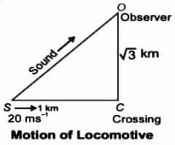
- 8A locomotive approaching a crossing at a speed of $20 \,ms ^{-1}$ sounds a whistle of frequency $640 \,Hz$ when $1 \,km$ from the crossing. There is no wind and the speed of sound in air is $330 \,ms ^{-1}$. What frequency is heard by an observer $\sqrt{3} \,km$ on the straight road from the crossing at right angle ......... $Hz$View Solution
- 9When a tuning fork $A$ of unknown frequency is sounded with another tuning fork $B$ of frequency $256 Hz$, then $3$ beats per second are observed. After that $A$ is loaded with wax and sounded, the again $3$ beats per second are observed. The frequency of the tuning fork $A$ is ..... $Hz$View Solution
- 10Statement $-1$ : Due to the motion of listener, the frequency of the sound waves (as received by listener) emitted by stationary source is affected.View Solution
Statement $-2$ : Due to the motion of source, wavelength of the sound waves (emitted by source) as received by stationary listener is affected.
Statement $-3$ : If receiver and source both are moving, the observed frequency must be different from the original frequency of source.
Treat motion of source or listener as always along a line joining them for all above cases.