In a standing wave on a string.
Medium


Download our appand get started for free
Experience the future of education. Simply download our apps or reach out to us for more information. Let's shape the future of learning together!No signup needed.*
Similar Questions
- 1A standing wave having $3$ nodes and $2$ antinodes is formed between two atoms having a distance $1.21\;\mathring A$ between them. The wavelength of the standing wave is .... $\mathop A\limits^o $View Solution
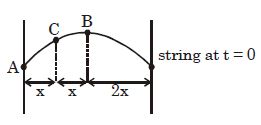
- 2A standing wave is established in single loop. At $t = 0$ , $K.E.$ of string is zero. Choose the correct optionView Solution
- 3View SolutionThe note"Saa" on the Sarod and the Sitar have the same pitch. The property of sound that is most important in distinguishing between the two instruments is
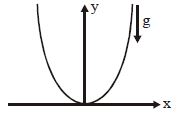
- 4A particle of mass $5 × 10^{-5}\ kg$ is placed at lowest point of smooth parabola $x^2$ = $40y$ ($x$ and $y$ in $m$) (in $rad/s$). If it is displaced slightly such that it is constrained to move along parabola, angular frequency of oscillation will be approximatelyView Solution
- 5Two waves represented by,View Solution
${y_1} = 10\,\sin \,200\pi t$,
${y_2} = 20\,\sin \,\left( {2000\pi t + \frac{\pi }{2}} \right)$
are superimposed at any point at a particular instant. The amplitude of the resultant wave is
- 6View SolutionA medium can carry a longitudinal wave because it has the property of
- 7A vibrating tuning fork is moving slowly and uniformly in a horizontal circular path of radius $8\,m$. The shortest distance of an observer in same plane from the tuning fork is $9 \,m$. The distance between the tuning fork and observer at the instant when apparent frequency becomes maximum is ......... $m$View Solution
- 8The vibration of a string fixed at both ends are described by $Y= 2 \,\,sin(\pi x) \,\,sin\,\,(100\pi t)$ where $Y$ is in $mm$,$x$ is in $cm$,$t$ in $sec$ thenView Solution
- 9Two points on a travelling wave having frequency $500\, Hz$ and velocity $300\, m/s$ are $60^o$ out of phase, then the minimum distance between the two points is ..... $m$View Solution
- 10A progressive wave travelling in positive $x$-direction given by $y=a \cos (k x-\omega t)$ meets a denser surface at $x=0, t=0$. The reflected wave is then given byView Solution