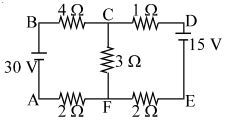
The figure shows a network of five resistances and two batteries Which of the batteries is getting charged.
Diffcult
Download our app for free and get started
Now, Applying Kircheffis law in the loop
$A B C F A$ :-
$\left.\Rightarrow 30 v-4 i_1\right.-3\left(i+i_1\right)-2(i)=0$
$\Rightarrow 30=4 i+3 i+3 i_1+2 i$
$\Rightarrow 9 i+3 i_1=30$
$\Rightarrow \quad 3 i+i_1=10$
$\Rightarrow \quad i=\frac{10-i_1}{3}-(1)$

Download our appand get started for free
Experience the future of education. Simply download our apps or reach out to us for more information. Let's shape the future of learning together!No signup needed.*
Similar Questions
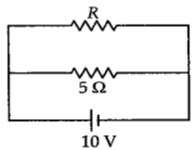
- 1he power dissipated in the circuit shown in the figure is $30\,W$. The value of $R$ is ............. $\Omega$View Solution
- 2Potentiometer wire of length $1 \,m$ is connected in series with $490\,\Omega $ resistance and $2\,V$ battery. If $0.2\, mV/cm $ is the potential gradient, then resistance of the potentiometer wire is ................ $\Omega$View Solution
- 3The resistance of the filament of an electric bulb changes with temperature. If an electric bulb rated $220\, volt$ and $100\, watt$ is connected $(220 \times 0.8)$ $volt$ sources, then the actual power would beView Solution
- 4$A$ wire of length $L$ and $3$ identical cells of negligible internal resistances are connected in series. Due to the current, the temperature of the wire is raised by $\Delta T$ in time $t. N$ number of similar cells is now connected in series with a wire of the same material and cross section but of length $2L$. The temperature of the wire is raised by the same amount $\Delta T$ in the same time $t$. The value of $N$ is :View Solution
- 5A potentiometer wire of length $100\, cm$ has a resistance of $10\, ohm.$ It is connected in series with a resistance and an accumulator of emf $2\,V$ and of negligible internal resistance. A source of emf $10\, mV$ is balanced against a length of $40\, cm$ of the potentiometer wire. What is the value of external resistance :- ................. $\Omega$View Solution
- 6A current $I$ is passing through a wire having two sections $P$ and $Q$ of uniform diameters $d$ and $d/2$ respectively. If the mean drift velocity of electrons in sections $P$ and $Q$ is denoted by $v_P$ and $v_Q$ respectively, thenView Solution
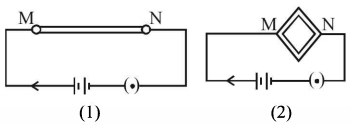
- 7A wire is connected to a battery between the point $M$ and $N$ as shown in the figure $(1)$. The same wire is bent in the form of a square and then connected to the battery between the points $M$ and $N$ as shown in the figure $(2)$. Which of the following quantities increases?View Solution
- 8By using only two resistance coils-singly, in series, or in parallel one should be able to obtain resistances of $3$, $4$, $12$ and $16\, ohms$. The separate resistances of the coil areView Solution
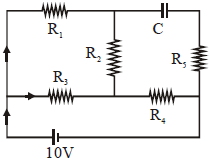
- 9An ideal cell of emf $10\, V$ is connected in circuit shown in figure. Each resistance is $2\, \Omega .$ The potential difference (in $V$) across the capacitor when it is fully charged isView Solution
- 10View SolutionPick out the wrong statement