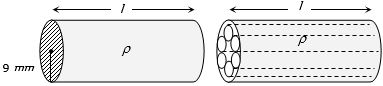
In an electrical cable there is a single wire of radius $9\, mm$ of copper. Its resistance is $5\,\Omega $. The cable is replaced by $6$ different insulated copper wires, the radius of each wire is $3\,mm$. Now the total resistance of the cable will be ............... $\Omega$
Diffcult


Download our appand get started for free
Experience the future of education. Simply download our apps or reach out to us for more information. Let's shape the future of learning together!No signup needed.*
Similar Questions
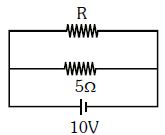
- 1The power dissipated in the circuit shown in the figure is $30\, Watts$. The value of $R$ is ............. $\Omega$View Solution
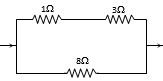
- 2Power dissipated across the $8 \,\,\Omega$ resistor in the circuit shown here is $2\,\, watt.$ The power dissipated in watt units across the $3 \,\,\Omega$ resistor isView Solution
- 3In an electrolyte $3.2 \times {10^{18}}$ bivalent positive ions drift to the right per second while $3.6 \times {10^{18}}$ monovalent negative ions drift to the left per second. Then the current isView Solution
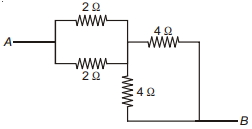
- 4Effective resistance across $A B$ in the network shown in .......... $\Omega$View Solution
- 5By what percentage will the illumination of the lamp decrease if the current drops by $20 \%$ ?View Solution
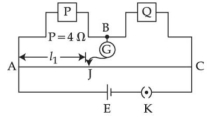
- 6Resistance are connected in a meter bridge circuit as shown in the figure. The balancing length $l_{1}$ is $40\,cm$. Now an unknown resistance $x$ is connected in series with $P$ and new balancing length is found to be $80\,cm$ measured from the same end. Then the value of $x$ will be $.......\Omega$View Solution
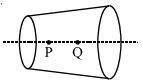
- 7A wire has a non-uniform cross-section as shown in figure.A steady current flows through it. The drift speed of electrons at points $P$ and $q$ is $v_P$ and $v_Q$.View Solution
- 8A hot electric iron has a resistance of $80\,\Omega $ and is used on a $200\, V$ source. The electrical energy spent, if it is used for two hours, will be ........... $Wh$View Solution
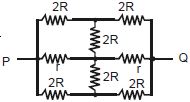
- 9The effective resistance between points $P$ and $Q$ of the electrical circuit shown in the figure isView Solution
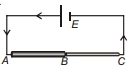
- 10In the following diagram, the lengths of wires $A B$ and $B C$ are equal, but the radius of wire $A B$ is double that of $B C$. The ratio of potential gradient on wires $A B$ and on $B C$ will be (wires are made of same material)View Solution