In an experiment of potentiometer for measuring the internal resistance of primary cell a balancing length $\ell $ is obtained on the potentiometer wire when the cell is open circuit. Now the cell is short circuited by a resistance $R$. If $R$ is to be equal to the internal resistance of the cell the balancing length on the potentiometer wire will be
AIEEE 2012, Medium


Download our appand get started for free
Experience the future of education. Simply download our apps or reach out to us for more information. Let's shape the future of learning together!No signup needed.*
Similar Questions
- 1A student obtained following observations in an experiment of meter bridge to find the unknown resistance of the circuit The most accurate value of unknown resistance is ............ $\Omega$View Solution
S.No. $R$ $l$ $100-l$ $S = \left( {\frac{{100 - l}}{l}} \right)R$ $1$ $20\,\Omega $ $43$ $57$ $26.51\,\Omega $ $2$ $30\,\Omega $ $51$ $49$ $28.82\,\Omega $ $3$ $40\,\Omega $ $59$ $41$ $27.80\,\Omega $ $4$ $60\,\Omega $ $70$ $30$ $25.71\,\Omega $ - 2$n$ identical cells each of $e.m.f.$ $E$ and internal resistance $r$ are connected in series. An external resistance $R$ is connected in series to this combination. The current through $R$ isView Solution
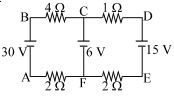
- 3The figure shows a network of four resistances and three batteries The current through the branch $CF$ is ............... $A$View Solution
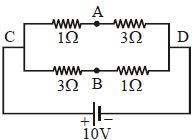
- 4A battery of $emf$ $10\,V$ is connected to resistances as shown in the figure. The potential difference between $A$ and $B,\,\,(V_A -V_B)$ is ................ $V$View Solution
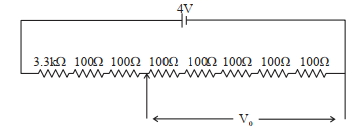
- 5A potential divider circuit is shown in figure. The output voltage $V_0$ isView Solution
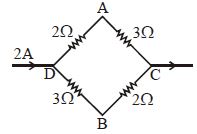
- 6The equivalent resistance of the given circuit between the terminals ${A}$ and ${B}$ is $....\Omega$View Solution
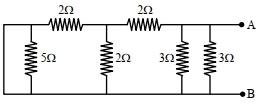
- 7Find the current in the $10\, \Omega$ resistanceView Solution
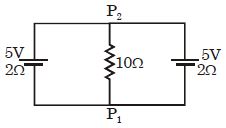
- 8A coil develops heat of $800\, cal/sec$. When $20\, volts$ is applied across its ends. The resistance of the coil is .............. $\Omega$ ($1$ $cal$ = $4.2$ $joule$)View Solution
- 9There is a current of $1.344\, amp$ in a copper wire whose area of cross-section normal to the length of the wire is $1\,m{m^2}$. If the number of free electrons per $c{m^3}$ is $8.4 \times {10^{22}}$, then the drift velocity would beView Solution
- 10A current of $2\, A$ flows in a system of conductors as shown. The potential difference $(V_A -V_B)$ will be ................ $\mathrm{V}$View Solution