In an experiment to verify Stokes law, a small spherical ball of radius $r$ and density $\rho$ falls under gravity through a distance $h$ in air before entering a tank of water. If the terminal velocity of the ball inside water is same as its velocity just before entering the water surface, then the value of $h$ is proportional to :
(ignore viscosity of air)
JEE MAIN 2020, Medium
Download our app for free and get started
After falling through h, the velocity be equal to terminal velocity
$\sqrt{2 gh }=\frac{2}{9} \frac{ r ^{2} g }{\eta}\left(\rho_{\ell}-\rho\right)$
$\Rightarrow h =\frac{2}{81} \frac{ r ^{4} g \left(\rho_{\ell}-\rho\right)^{2}}{\eta^{2}}$
$\Rightarrow h \propto r ^{4}$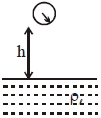

Download our appand get started for free
Experience the future of education. Simply download our apps or reach out to us for more information. Let's shape the future of learning together!No signup needed.*
Similar Questions
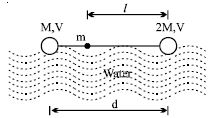
- 1A dumbbell is placed in water of density $\rho$ . It is observed that by attaching a mass $m$ to the rod, the dumbbell floats with the rod horizontal on the surface of water and each sphere exactly half submerged as shown in the figure. The volume of the mass $m$ is negligible. The value of length $l$ isView Solution
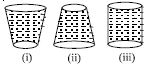
- 2View SolutionThe three water filled tanks shown have the same volume and height. If small identical holes are punched near this bottom, which one will be the first to get empty.
- 3A plane is in level flight at constant speed and each of its two wings has an area of $25 \;m ^{2}$ If the speed of the air is $180 \;km / h$ over the lower wing and $234\; km / h$ over the upper wing surface, determine the plane's mass in $kg$. (Take air density to be $1\; kg m ^{-3}$ ).View Solution
- 4Water is flowing in a pipe of diameter $ 4 cm$ with a velocity $3 m/s. $ The water then enters into a tube of diameter $ 2 cm.$ The velocity of water in the other pipe is .......... $m/s$View Solution
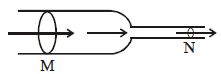
- 5Horizontal tube of non-uniform cross-section has radii of $0.1\,m$ and $0.05\,m$ respectively at $M$ and $N.$ For a stream-line flow of liquid the rate of liquid flow isView Solution
- 6Under a pressure head the rate of orderly volume flow of a liquid through a capillary tube is $Q$ . If the length of capillary tube is doubled and the diameter of tube is halved, the rate of flow would becomeView Solution
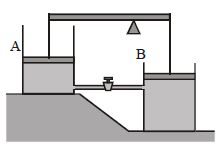
- 7In the arrangement shown both the vessels $A$ and $B$ are identical but amount of water in $B$ is double of that in $A$. The vessels are closed by identical leak proof pistons at the same height. The pistons are connected to the ends of lever arm. There is no friction between the pistons and the container walls. The system is in equilibrium in the situation shown. Now the valve in the horizontal tube connecting both the vessels is opened. In which direction will the water flow through the tube ?View Solution
- 8Consider two solid spheres $\mathrm{P}$ and $\mathrm{Q}$ each of density $8 \mathrm{gm} \mathrm{cm}^{-3}$ and diameters $1 \mathrm{~cm}$ and $0.5 \mathrm{~cm}$, respectively. Sphere $\mathrm{P}$ is dropped into a liquid of density $0.8 \mathrm{gm} \mathrm{cm}^{-3}$ and viscosity $\eta=3$ poiseulles. Sphere $Q$ is dropped into a liquid of density $1.6 \mathrm{gm} \mathrm{cm}^{-3}$ and viscosity $\eta=2$ poiseulles. The ratio of the terminal velocities of $\mathrm{P}$ and $\mathrm{Q}$ isView Solution
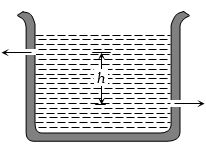
- 9There are two identical small holes of area of cross-section a on the opposite sides of a tank containing a liquid of density $\rho $. The difference in height between the holes is $h$. Tank is resting on a smooth horizontal surface. Horizontal force which will has to be applied on the tank to keep it in equilibrium isView Solution
- 10The figure shows a liquid of given density flowing steadily in horizontal tube of varying cross-section. Cross sectional areas at $A$ is $1.5\,cm ^2$, and $B$ is $25\,mm ^2$, if the speed of liquid at $B$ is $60\,cm / s$ then $\left( P _{ A }- P _{ B }\right)$ is :(Given $P _{ A }$ and $P _{ B }$ are liquid pressures at $A$ and $B$ points.Density $\rho=1000\,kg\,m ^{-3}$View Solution
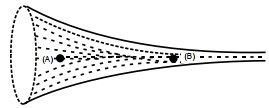
$A$ and $B$ are on the axis of tube $............\,Pa$