Question
In beta decay, an electron (or a positron) is emitted by a nucleus. Does the remaining atom get oppositely charged?

Answer

In beta decay, a neutron from the nucleus is converted to a proton releasing an electron and an antineutrino or a proton is converted to a neutron releasing a positron and a neutrino.
$\beta^-\text{decay:}\text{ n}\rightarrow\text{p + e + }\vec{\text{v}}$
$\beta^+\text{decay:}\text{ p}\rightarrow\text{n + e}^+ + \text{v}$
Since the number of valence electrons present in the parent atom do not change, the remaining atom does not get oppositely charged. Instead, due to a change in the atomic number, there's a formation of a new element.

Need a full question paper?

Generate a complete, print-ready paper with questions like this in minutes — across 16+ boards, with answer keys.
Start Generating Free

Similar questions

A parallel-plate capacitor having plate area 20cm2 and separation between the plates 1.00mm is connected to a battery of 12.0V. The plates are pulled apart to increase the separation to 2.0mm.
  1. Calculate the charge flown through the circuit during the process.
  2. How much energy is absorbed by the battery during the process?
  3. Calculate the stored energy in the electric field before and after the process.
  4. Using the expression for the force between the plates, find the work done by the person pulling the plates apart.
  5. Show and justify that no heat is produced during this transfer of charge as the separation is increased.
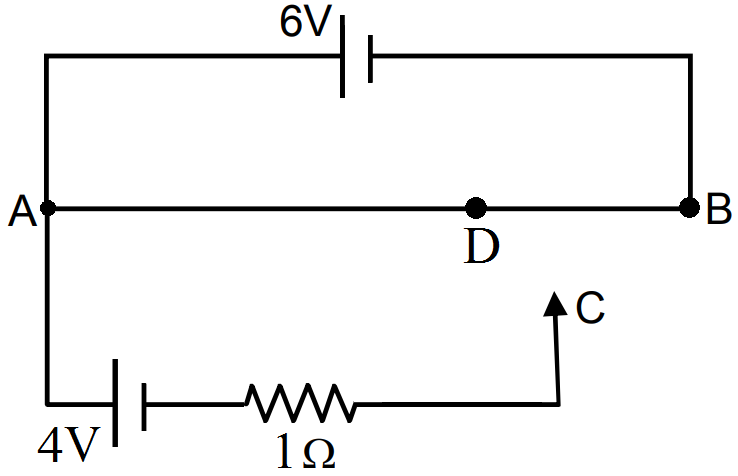
A 6 volt battery of negligible internal resistance is connected across a uniform wire AB of length 100cm. The positive terminal of another battery of emf 4V and internal resistance $1\Omega$ is joined to the point A, as shown in the figure. Take the potential at B to be zero. (a) What are the potentials at the points A and C? (b) At which point D of the wire AB, the potential is equal to the potential at C? (c) If the points C and D are connected by a wire, what will be the current through it? (d) If the 4V battery is replaced by a 7.5V battery, what would be the answers of parts (a) and (b)?

A particle is observed from two frames S1 and. S2. The frame Smoves with respect to Swith an acceleration a. Let F1 and F2 be the pseudo forces on the particle when seen from S1 and S2 respectively. Which of the following are not possible?
  1. F1 = 0, F2 ≠ 0
  2. F1 ≠ 0, F2 = 0
  3. F1 ≠ 0, F2 ≠ 0
  4. F= 0, F= 0
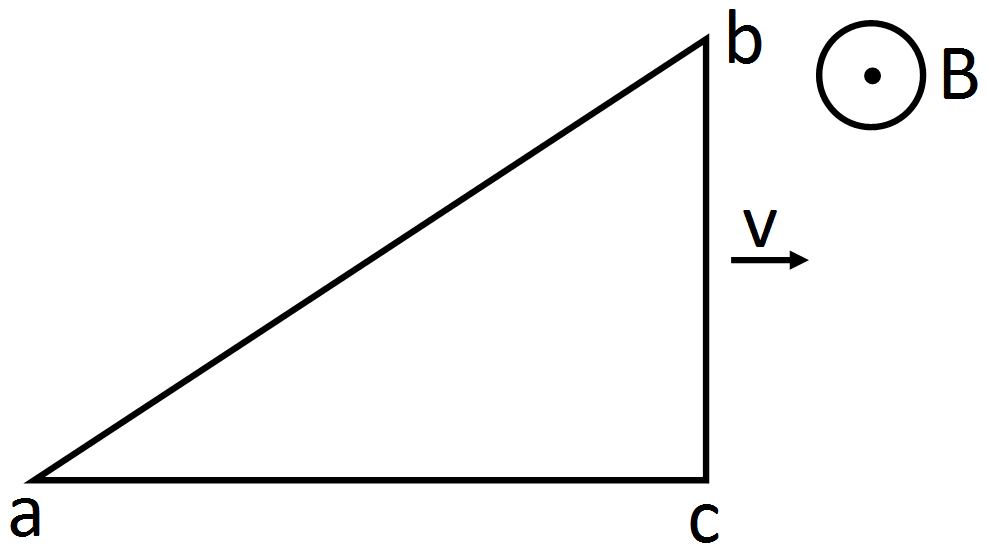
A right-angled triangle abc, made from a metallic wire, moves at a uniform speed v in its plane as shown in figure. A uniform magnetic field B exists in the perpendicular direction. Find the emf induced:
  1. In the loop abc.
  2. In the segment bc.
  3. In the segment ac.
  4. In the segment ab.

Check that the ratio ke2/G memp is dimensionless. Look up a Table of Physical Constants and determine the value of this ratio. What does the ratio signify?
What is interference of light? Write two essential conditions for sustained interference pattern to be produced on the screen.
Draw a graph showing the variation of intensity versus the position on the screen in Young’s experiment when (a) both the slits are opened and (b) one of the slits is closed.
What is the effect on the interference pattern in Young’s double slit experiment when:
  1. Screen is moved closer to the plane of slits?
  2. Separation between two slits is increased?
Explain your answer in each case.
A uniform electric field $\vec{\text{E}}=\text{E}_\text{x}\hat{\text{i}}$ N/ C for x > 0 and $\vec{\text{E}}=-\text{E}_\text{x}\hat{\text{i}}$ N/ C for x < 0 are given. A right circular cylinder of length l cm and radius r cm has its centre at the origin and its axis along the X-axis. Find out the net outward flux. Using Gauss’s law, write the expression for the net charge within the cylinder.
What do you understand by self-induction?Obtain an expression for self-induction of a solenoid.###Define self-induction. Obtain an expression for self-induction of a solenoid of N turns, length $l$ and area of cross-section A.
Describe the potential energy of an electric dipole in an external field in different positions also draw the diagram.
A capacitor of capacitance C is given a charge Q. At t = 0, it is connected to an uncharged capacitor of equal capacitance through a resistance R. Find the charge on the second capacitor as a function of time.