MCQ
In case of a freely falling body, the ratio of kinetic energy at the end of the third second increase in kinetic energy in the next three seconds is:
  • A
    $1 : 1$
  • B
    $1 : 2$
  • $1 : 3$
  • D
    $1 : 9$

Answer

Correct option: C.
$1 : 3$
$c.\ 1 : 3$

Need a full question paper?

Generate a complete, print-ready paper with questions like this in minutes — across 16+ boards, with answer keys.
Start Generating Free

Similar questions

A moves with $65 \,km/h $ while $B$ is moving in same direction of $A$ with $80\, km/h$. The relative velocity of $B$ with respect to $A$ is......... $km/h$
A glass flask is filled up to a mark with $50\, cc$ of mercury at $18°C.$ If the flask and contents are heated to $38°C.$ ......... $cc$ mercury will be above the mark $?$ $(\alpha$ for glass is $ 9 × 10^{-6}{°}C^{-1}$ and coefficient of real expansion of mercury is $180 × 10^{-6}{°}C^{-1})$ 
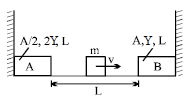
In the given figure, two elastic rods $A$ & $B$ are rigidly joined to end supports. $A$ small mass $‘m’$ is moving with velocity $v$ between the rods. All collisions are assumed to be elastic & the surface is given to be frictionless. The time period of small mass $‘m’$ will be : [$A=$ area of cross section, $Y =$ Young’s modulus, $L=$ length of each rod ; here, an elastic rod may be treated as a spring of spring constant $\frac{{YA}}{L}$ ]
Equation of travelling wave on a stretched string of linear density $5\,g/m$ is $y = 0.03\,sin\,(450\,t -9x)$ where distance and time are measured in $SI$ united. The tension in the string is ... $N$
The mean free path for air molecule with average speed $18.5 \mathrm{~ms}^{-1}$ at $\text{STP}$ is $($Take, $\mathrm{d}=2 \times 10^{-10} \mathrm{~m}$ and $\mathrm{n}=2.7 \times 10^{25} \mathrm{~m}^{-3} )$
Dimensions of potential energy are
A ball hits a floor and rebounds after an inelastic collision. In this case:
The coefficient of friction between tyres and the road is $0.1.$ Find the maximum speed allowed by traffic police for cars to cross a circular turn of radius $10m$ to prevent accident.
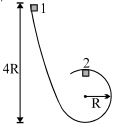
$A$ small cube with mass $M$ starts at rest at point $1$ at a height $4R$, where $R$ is the radius of the circular part of the track. The cube slides down the frictionless track and around the loop. The force that the track exerts on the cube at point $2$ is nearly ......... times the cube's weight $mg$.
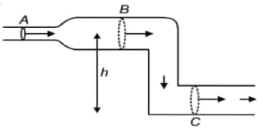
Water is flowing through a channel (lying in a vertical plane) as shown in the figure. Three sections $A, B$ and $C$ are shown. Sections $B$ and $C$ have equal area of cross section. If $P_A, P_B$ and $P_C$ are the pressures at $A, B$ and $C$ respectively then