Question
In changing the state of a gas adiabatically from an equilibrium state A to another equilibrium state B, an amount of work equal to 22.3J is done on the system. If the gas is taken from state A to B via a process in which the net heat absorbed by the system is 9.35 cal, how much is the net work done by the system in the latter case? (Take 1 cal = 4.19J)
Answer

The work done (W) on the system while the gas changes from state A to state B is 22.3J. This is an adiabatic process. Hence, change in heat is zero.$\therefore\Delta\text{Q} = 0$
$\Delta\text{W} = -22.3\text{ J}$ (Since the work is done on the system)
From the first law of thermodynamics, we have: $\Delta\text{Q}=\Delta\text{U}+\Delta\text{W}$ Where, ΔU = Change in the internal energy of the gas$\therefore\ \Delta\text{U}=\Delta\text{Q}-\Delta\text{W}=-(-22.3\text{ J})$
$\Delta\text{U} = +22.3\text{ J}$
When the gas goes from state A to state B via a process, the net heat absorbed by the system is:$\Delta\text{Q} = 9.35\text{ cal}$
= 9.35 × 4.19 = 39.1765J Heat absorbed, $\Delta\text{Q}=\Delta\text{U}+\Delta\text{Q}$$\therefore\ \Delta\text{W}=\Delta\text{Q}-\Delta\text{U}$
= 39.1765 - 22.3 = 16.8765 Therefore, 16.88J of work is done by the system.

Need a full question paper?

Generate a complete, print-ready paper with questions like this in minutes — across 16+ boards, with answer keys.

Start Generating Free

Similar questions

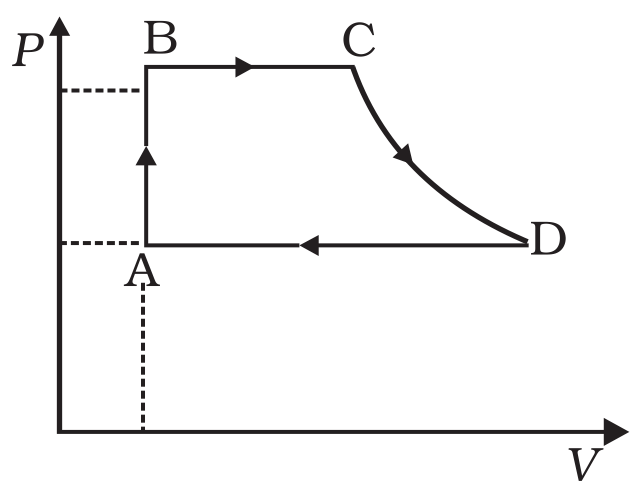
A cycle followed by an engine (made of one mole of an ideal gas in a cylinder with a piston) is shown in Fig. Find heat exchanged by the engine, with the surroundings for each section of the cycle. $(C_v = (3/2) R)$

AB : constant volume
BC : constant pressur CD : adiabati DA : constant pressure
A shell of mass $0.020kg$ is fired by a gun of mass $100kg$. If the muzzle speed of the shell is $80ms^{-1}$, what is the recoil speed of the gun?
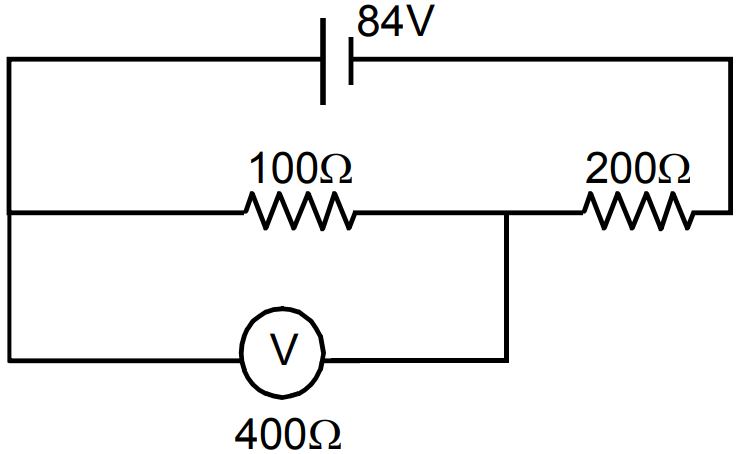
A voltmeter of resistance $400\Omega$ is used to measure the potential difference across the $100\Omega$ resistor in the circuit shown in the figure. (a) What will be the reading of the voltmeter? (b) What was the potential difference across $100\Omega$ before the voltmeter was connected?
An ammeter is to be constructed that can read currents up to 2.0A. If the coil has resistance of $25\Omega$ and takes 1mA for full-scale deflection, what should be the resistance of the shunt used?
What is gravitational potential? Derive the formula for gravitational potential due to a ponit mass and also draw the graph.
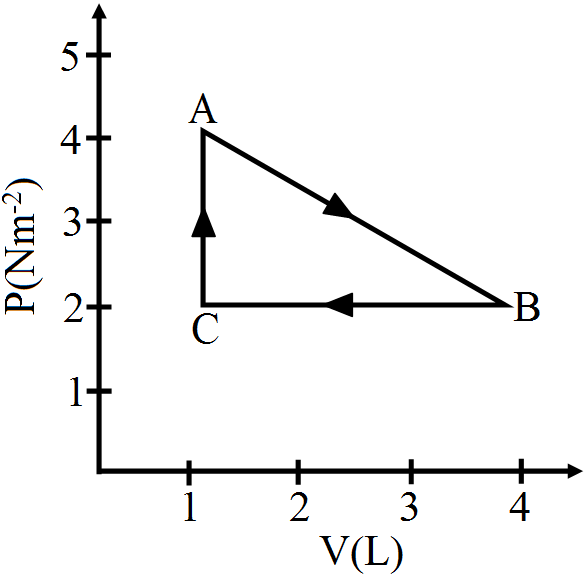
The P-V diagram for a cyclic process is a triangle ABC drawn in order. The co-ordinates of A, B, C are $(4,1),(2,4)$ and $(2,1)$. The co-ordinates are in the order ( $\mathrm{P}-\mathrm{V}$ ). Pressure is in $\mathrm{Nm}^{-2}$ and volume is in litre. Calculate work done during the process from A to $\mathrm{B}, \mathrm{B}$ to C and C to A . Also, calculate work done in the complete cycle.
A charge Q is uniformly distributed on a thin spherical shell. What is the field at the centre of the shell? If a point charge is brought close to the shell, will the field at the centre change? Does your answer depend on whether the shell is conducting or nonconducting?
An air bubble of radius $2.0mm$ is formed at the bottom of a $3.3m$ deep river. Calculate the radius of the bubble as it comes to the surface. Atmospheric pressure = $1.0 \times 10^5$ Pa and density of water = $1000kg/m^{-3}$.
  1. Define escape velocity.
  2. Derive expression for the escape velocity of an object from the surface of a planet.
  3. Does it depend on location from where it is projected?
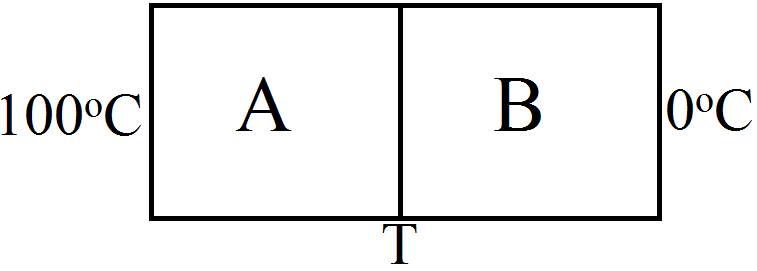
Two metal cubes $A$ and $B$ of same size are arranged as shown in figure. The extreme ends of the combination are maintained at the indicated temperatures. The arrangement is thermally insulated. The coefficient of thermal conductivity of $A$ and $B$ are $300 W/m  {}^\circ C$ and $200 W/m  {}^\circ C$ respectively. After steady state is reached, what will be the temperature T of the interface?