MCQ
In damped oscillations, damping force is directly proportional to speed of oscillator. If amplitude becomes half of its maximum value in $1 \,s$, then after $2 \,s$ amplitude will be $\left(A_0-\right.$ initial amplitude)
  • $\frac{1}{4} A_0$
  • B
    $\frac{1}{2} A_0$
  • C
    $A_0$
  • D
    $\frac{\sqrt{3} A_0}{2}$

Answer

Correct option: A.
$\frac{1}{4} A_0$
a
(a)

$A=A_0 e^{-b t}$

Amplitude becomes half hence

$\frac{A_0}{2} A_0 e^{-b t}[t=1]$

$\therefore e^{-b}=\frac{1}{2}$

$\therefore \text { In two seconds }$

$A=A_0\left(\frac{1}{2}\right)^2$

$A=\frac{A_0}{4}$

Need a full question paper?

Generate a complete, print-ready paper with questions like this in minutes — across 16+ boards, with answer keys.

Start Generating Free

Similar questions

A resonance tube is old and has jagged end. It is still used in the laboratory to determine velocity of sound in air. A tuning fork of frequency $512\,Hz$ produces first resonance when the tube is filled with water to a mark $11\,cm$ below a reference mark, near the open end of the tube. The experiment is repeated with another fork of frequency $256\,Hz$ which produces first resonance when water reaches a mark $27\,cm$ below the reference mark. The velocity of sound in air, obtained in the experiment, is close to .... $ms^{-1}$
Starting at temperature $300\; \mathrm{K},$ one mole of an ideal diatomic gas $(\gamma=1.4)$ is first compressed adiabatically from volume $\mathrm{V}_{1}$ to $\mathrm{V}_{2}=\frac{\mathrm{V}_{1}}{16} .$ It is then allowed to expand isobarically to volume $2 \mathrm{V}_{2} \cdot$ If all the processes are the quasi-static then the final temperature of the gas (in $\left. \mathrm{K}\right)$ is (to the nearest integer)
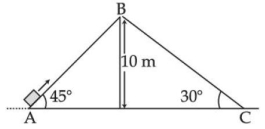
Two inclined planes are placed as shown in figure.

A block is projected from the Point $A$ of inclined plane $A B$ along its surface with a velocity just sufficient to carry it to the top Point $B$ at a height $10 m$. After reaching the Point $B$ the block slides down on inclined plane $BC$. Time it takes to reach to the point $C$ from point $A$ is $t (\sqrt{2}+1) s$. The value of $t$ is........(use $g =10 m / s ^{2}$ )

A 60kg man pushes a 40kg man by a force of 60N. The 40kg man has pushed the other man with a force of:
If $\overrightarrow{ F }=(20 \hat{i}+15 \hat{j}-5 \hat{k})$ and $\overrightarrow{ v }=(6 \hat{i}-4 \hat{j}+3 \hat{k}) m / s$ then the instantaneous power will be :
Hook's law defines
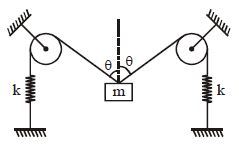
In the situation as shown in figure time period of vertical oscillation of block for small displacements will be 
A $ U$ tube of uniform bore of cross-sectional area $A$ has been set up vertically with open ends facing up. Now $m$ gm of a liquid of density $d$ is poured into it. The column of liquid in this tube will oscillate with a period $T$ such that
The angular speed of truck wheel is increased from $900\, rpm$ to $2460\, rpm$ in $26$ seconds. The number of revolutions by the truck engine during this time is

(Assuming the acceleration to be uniform).

Two cars OF SAME LENGTH move in the same direction along parallel roads. One of them is a $100\ m$ long travelling with a velocity of $7.5\  ms^{−1}.$ How long will it take for the first car to overtake the second car?