Question
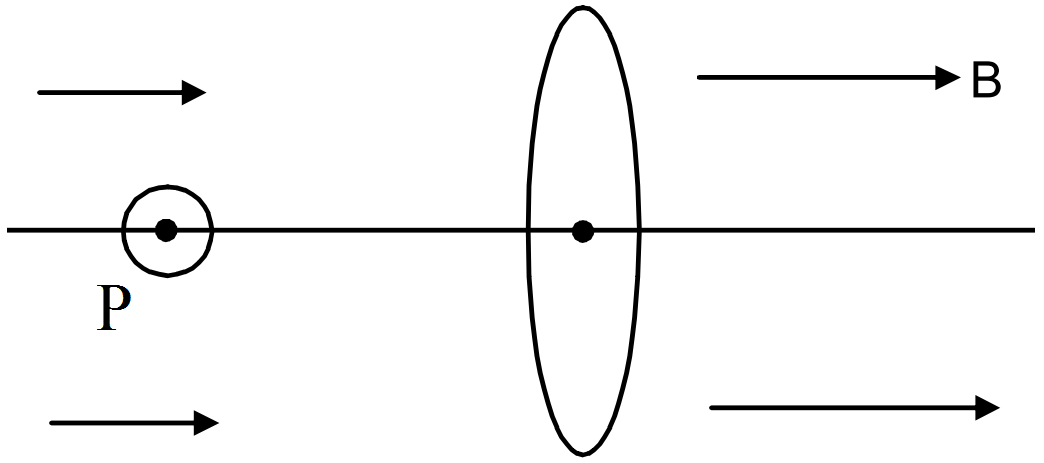
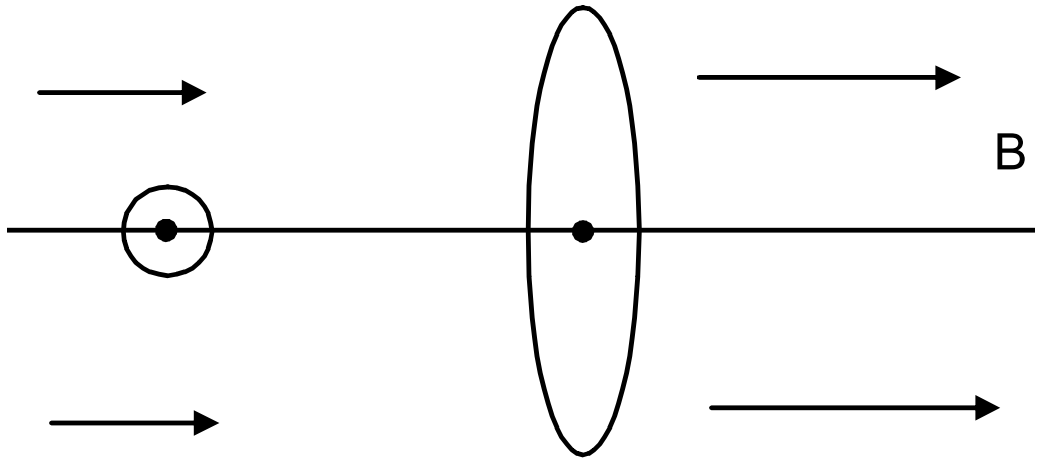
Shows a convex lens of focal length $12cm$ lying in a uniform magnetic field B of magnitude $1.2T$ parallel to its principal axis. A particle with charge $2.0 \times 10^{-3}C$ and mass $2.0 \times 10^{-5} kg$ is projected perpendicular to the plane of the diagram with a speed of $4.8 ms^{-1}$​​​​​​​. The particle moves along a circle with its centre on the principal axis at a distance of $18cm$ from the lens. Show that the image of the particle moves along a circle and find the radius of that circle.
Answer


The object will make a circular path, perpendicular to the plance of paper Let the radius of the object be r.
$\frac{\text{mv}^2}{\text{r}}=\text{qvB}\Rightarrow\text{r}=\frac{\text{mV}}{\text{qB}}$
Here object distance K = 18cm.
$\frac{1}{\text{v}}-\frac{1}{\text{u}}=\frac{1}{\text{f}}$ (lens eqn.) $\Rightarrow\frac{1}{\text{v}}-\Big(\frac{1}{-18}\Big)=\frac{1}{12}\Rightarrow\text{v}=36\text{cm}.$
Let the radius of the circular path of image = r'
So magnification $=\frac{\text{v}}{\text{u}}=\frac{\text{r}'}{\text{r}}\Big(\text{magnetic path}=\frac{\text{image height}}{\text{object height}}\Big)$
$\Rightarrow\text{r}'=\frac{\text{v}}{\text{u}}\text{r}$
$\Rightarrow\text{r}'=\frac{36}{18}\times4=8\text{cm}$
Hence radius of the circular path in which the image moves is 8cm

Need a full question paper?

Generate a complete, print-ready paper with questions like this in minutes — across 16+ boards, with answer keys.

Start Generating Free

Similar questions

Two particles, each of mass m and speed v, travel in opposite directions along parallel lines separated by a distance d. Show that the angular momentum vector of the two particle system is the same whatever be the point about which the angular momentum is taken.
A bucket full of water is placed in a room at $15^\circ C$ with initial relative humidity $40\%$. The volume of the room is $50m^3.$
  1. How much water will evaporate?
  2. lf the room temperature is increased by $5^\circ C, $ how much more water will evaporate? The saturation vapour pressure of water at $15^\circ C$ and $20^\circ C$ are $1.6$kPa and $2.4$kPa respectively.
Separation of Motion of a system of particles into motion of the centre of mass and motion about the centre of mass: Show $\text{K}=\text{K}'+\frac{1}{2}\text{M}\text{V}^2$ where K' is the total kinetic energy of the system of particles, K′ is the total kinetic energy of the system when the particle velocities are taken with respect to the centre of mass and $\frac{\text{MV}^2}{2}$ is the kinetic energy of the translation of the system as a whole (i.e. of the centre of mass motion of the system). The result has been used in $\sec7.14$
Determine the position of centre of mass of a uniform semicircular wire of radius R.
A rain drop of radius $2mm$ falls from a height of $500m$ above the ground. It falls with decreasing acceleration (due to viscous resistance of the air) until at half its original height, it attains its maximum (terminal) speed, and moves with uniform speed thereafter. What is the work done by the gravitational force on the drop in the first and second half of its journey? What is the work done by the resistive force in the entire journey if its speed on reaching the ground is $10 m s^{-1}$?
A marble rolls along a table at a constant speed of $1.00 m / s$ and then falls off the edge of the table to the floor 1.00 m below,
i. How long does the marble take to reach the floor?
ii. At what horizontal distance from the edge of the table does the marble land?
iii. What is its velocity as it strikes the floor?
Two absolute scales $A$ and $B$ have triple points of water defined to be $200A$ and $350B$. What is the relation between $TA$ and $TB$?
In a refrigerator one removes heat from a lower temperature and deposits to the surroundings at a higher temperature. In this process, mechanical work has to be done which is provided by an electric motor. If the motor is of $1KW$ power, and heat is transferred from $–3^\circ C to 27^\circ C$, find the heat taken out of the refrigerator per second assuming its efficiency is 50% of a perfect engine.
The angle between the resultant contact force and the normal force exerted by a body on the other is called the angle of friction. Show that, if $\lambda$ be the angle of friction and la the coefficient of static friction, $\lambda\leq\tan^{-1}\mu.$
An electron makes $3 \times 10^5$ revolutions per second in a circle of radius $0.5$ angstrom. Find the magnetic field B at the centre of the circle.