Question
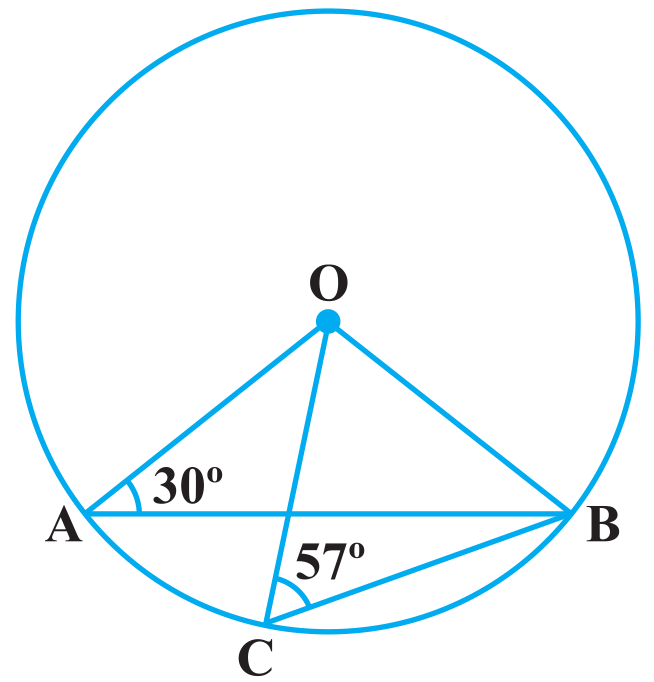
In Fig. $\angle\text{OAB} = 30^\circ$ and $\angle\text{OCB} = 57^\circ.$ Find $\angle\text{BOC}$ and $\angle\text{AOC}.$
Answer

Given, $\angle\text{OAB}=30^\circ$ and $\angle\text{OCB}=57^\circ$ In
$\triangle\text{AOB},\ \ \ \text{AO}=\text{OB}$ [both are the radius of a circle]
$\Rightarrow\angle\text{OBA}=\angle\text{BAO}=30^\circ$ [angle opposite to equal sides are equal] In $\triangle\text{AOB},$
$\Rightarrow\angle\text{AOB}+\angle\text{OBA}+\angle\text{BAO}=180^\circ$ [by angle sum property of a triangle]
$\therefore\angle\text{AOB}+30^\circ+30^\circ=180^\circ$
$\therefore\angle\text{AOB}=180^\circ-2(30^\circ)$
$=180^\circ-60^\circ=120^\circ\ \ \ ...(\text{i})$
Now, in $\triangle\text{OCB}, OC = OB[ $ both are the radius of a circle$]$
$\Rightarrow\angle\text{OBC}=\angle\text{OCB}=57^\circ$ [angle opposite to equal sides are equal] In $\triangle\text{OCB}$
$\angle\text{COB}+\angle\text{OCB}+\angle\text{CBO}=180^\circ[$ by angle sum property of triangle$]$ $\therefore\angle\text{COB}=180^\circ-(\angle\text{OCB}+\angle\text{OBC})$
$=180^\circ-(57^\circ+57^\circ)$
$=180^\circ-114^\circ=66^\circ\ \ ...(\text{ii})$ From Eq. $(i),$
$\angle\text{AOB}=120^\circ$
$\Rightarrow\angle\text{AOC}+\angle\text{COB}=120^\circ$
$\Rightarrow\angle\text{AOC}+66^\circ=120^\circ[$ from Eq. $(ii)]$
$\therefore\angle\text{AOC}=120^\circ-66^\circ=54^\circ$

Need a full question paper?

Generate a complete, print-ready paper with questions like this in minutes — across 16+ boards, with answer keys.
Start Generating Free

Similar questions

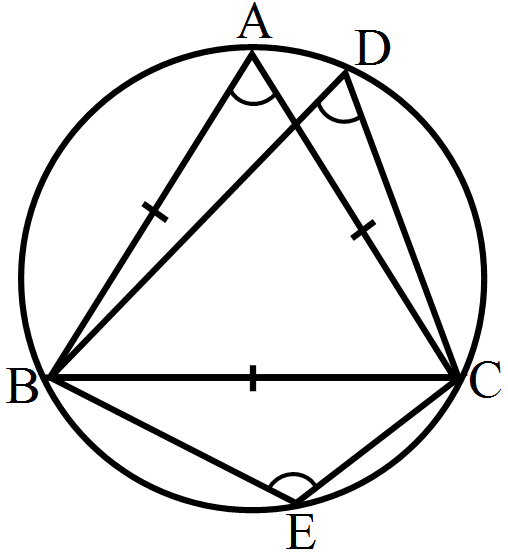
In the given figure, $\triangle\text{ABC}$ is equilateral. Find
$i. \angle\text{BDC}$
$ii. \angle\text{BEC}$
Give a geometrical construction for finding the fourth point lying on a circle passing through three given points, without finding the centre of the circle. Justify the construction.
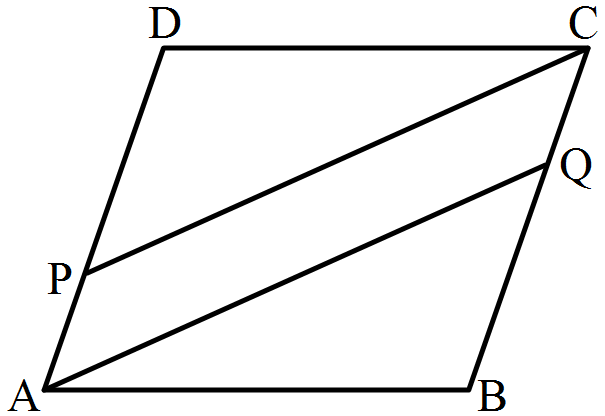
In the adjoining figure, $ABCD$ is a parallelogram. If $P$ and $Q$ are points on $AD$ and $BC$ respectively such that $\text{AP}=\frac{1}{2}\text{AD}$ and $\text{CQ}=\frac{1}{2}\text{BC},$ prove that $AQCP $is a parallelogram.
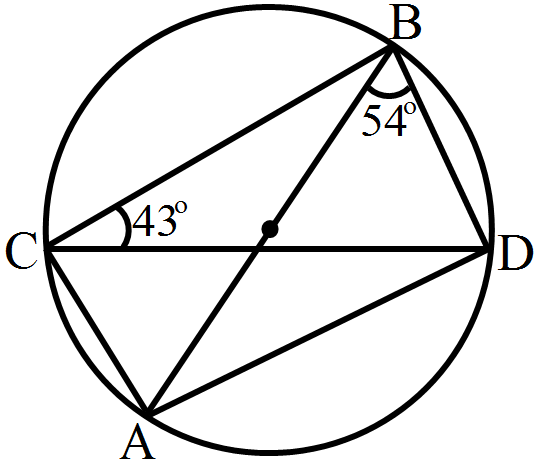
In the given figure, $\angle\text{ABD}=54^\circ$ and $\angle\text{BCD}=43^\circ,$ calculate
$i. \angle\text{ACD}$
$ii. \angle\text{BAD}$
$iii. \angle\text{BDA}$
Locate $\sqrt{3}$ on the number line.
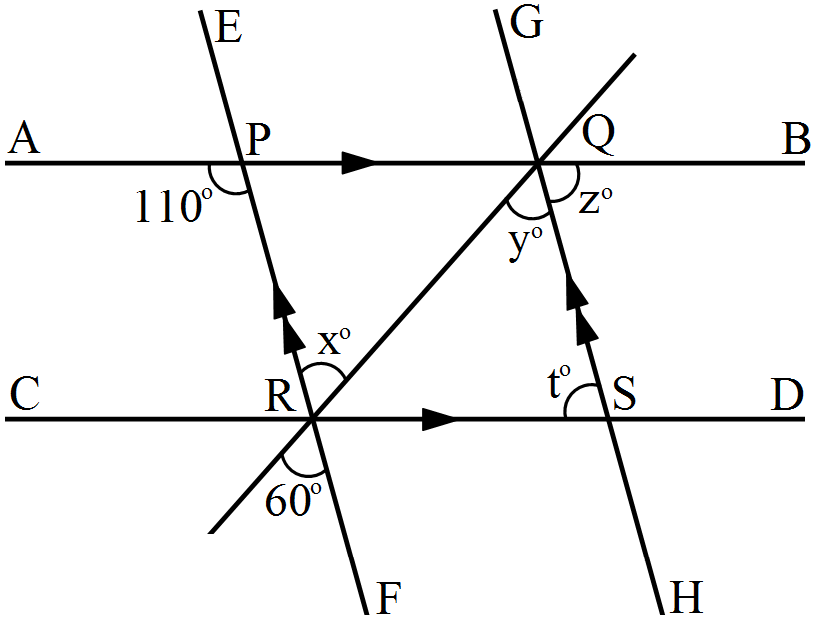
In the given figure, $AB\ ||\ CD$ and $EF\ ||\ GH$. Find the value of $x, y, z$ and $t.$
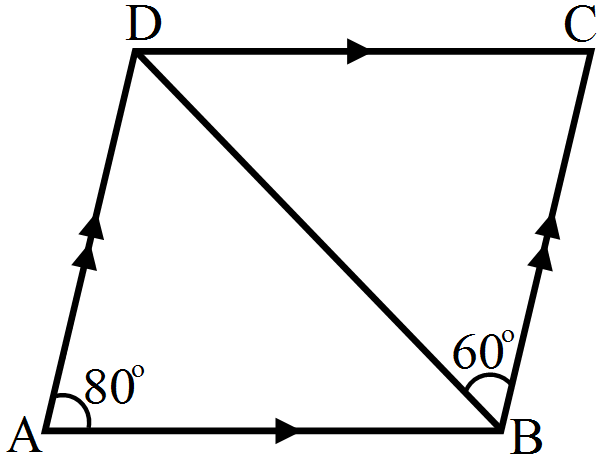
In the adjoining figure, $ABCD$ is a parallelogram in which $\angle\text{DAB}=80^{\circ}$ and $\angle\text{DBC}=60^{\circ}.$ Calculate $\angle\text{CDB}$ and $\angle\text{ADB}.$
The heights of $75$ students in a school are given below:
Height (in cm)
$130-136$
$136-142$
$142-148$
$148-154$
$154-160$
$160-166$
Number of students
$9$
$12$
$18$
$23$
$10$
$3$
Draw a histogram to represent the above data.
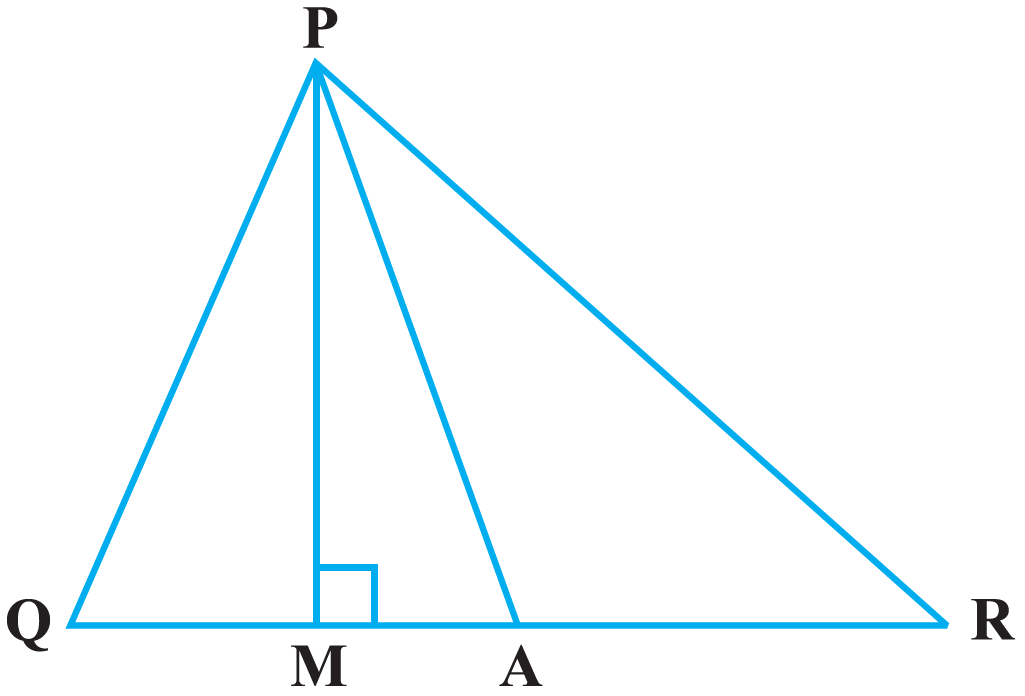
In Fig. $\angle\text{Q}>\angle\text{R}, PA$ is the bisector of $\angle\text{QPR}$ and $\text{PM}\perp\text{QR}$ Prove that $\angle\text{APM}=\frac{1}{2}(\angle\text{Q}-\angle\text{R}).$