MCQ
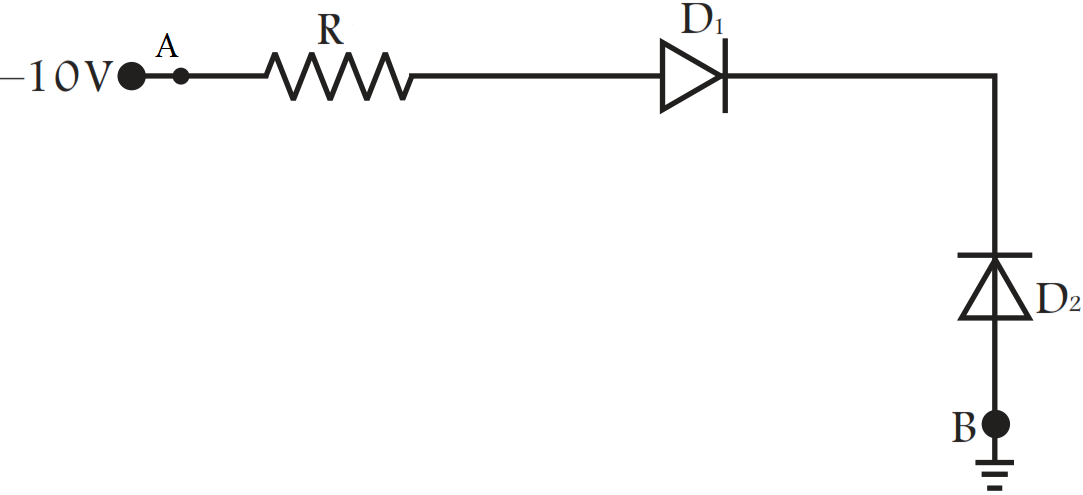
In Fig., assuming the diodes to be ideal:
  • A
    D1 is forward biased and D2 is reverse biased and hence current flows from A to B.
  • B
    D2 is forward biased and D1 is reverse biased and hence no current flows from B to A and vice versa.
  • C
    D1 and D2 are both forward biased and hence current flows from A to B.
  • D
    D1 and D2 are both reverse biased and hence no current flows from A to B and vice versa.
Answer

  1. D2 is forward biased and D1 is reverse biased and hence no current flows from B to A and vice versa.

Solution:

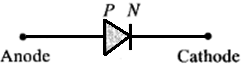
A symbol of the diode is represented like this: In this problem first we have to check the polarity of the diodes. -10 is the lower voltage in the circuit. Now p-side of p-n juction D1 is connected to lower voltage and n-side of D1 to higher voltage. Thus D1 is reverse biased. Now, let us analyse 2nd diode of the given circuit. The p-side of p-n junction D1 is at higher potential and n-side of D2 is at lower potential. Therefore D2 is forward biased.

Hence, current flows through the jucntion from B to A.

Need a full question paper?

Generate a complete, print-ready paper with questions like this in minutes — across 16+ boards, with answer keys.

Start Generating Free

Similar questions

Mark the correct options:
  1. If the far point goes ahead, the power of the divergent lens should be reduced.
  2. If the near point goes ahead, the power of the convergent lens should be reduced.
  3. If the far point is 1 m away from the eye, divergent lens should be used.
  4. If the near point is 1 m away from the eye, divergent lens should be used.

A radioactive sample is a-emitter with half life 138.6 days is observed by a student to have 2000 disintegration/sec. The number of radioactive nuclei for given activity are

(a) 3.45 × 10¹⁰

(b) 1 × 10¹⁰

(c) 3.45 × 10¹⁵

(d) 2.75 × 10¹¹

Two conductors made of the same material are connected across a common potential difference. Conductor A has twice the diameter and twice the length of conductor B. The power delivered to the two conductors  and   respectively is such that   equals to

(a) 0.5

(b) 1.0

(c) 1.5 

(d) 2.0

The instrument that is based on the principle that when an object is placed between first principal focus and the optic centre of convex lens, an upright, virtual and enlarged image on the same side of the object is formed, is:

If a linear isotropic dielectric is placed in an electric field of strength E, then the polarization P is:

A person can see clearly only upto a distance of 25 cm. He wants to read a book placed at a distance of 50 cm. What kind of lens does he require for his spectacles and what must be its power

(a)  Concave, – 1.0 D

(b)  Convex,  + 1.5 D

(c)  Concave, – 2.0 D

(d)  Convex, + 2.0 D

Surface temperature of the sun is of the order of

(a) 5000 K

(b) 7000 K

(c) 6000 K

(d) 12000 K

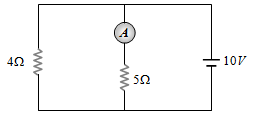
In the circuit, the reading of the ammeter is (assume internal resistance of the battery be zero)

(a)  

(b)  

(c)  

(d) 2 A

A far sighted man who has lost his spectacles, reads a book by looking through a small hole (3-4 mm) in a sheet of paper. The reason will be

(a) Because the hole produces an image of the letters at a longer distance 

(b) Because in doing so, the focal length of the eye lens is effectively increased 

(c)  Because in doing so, the focal length of the eye lens is effectively decreased

(d) None of these

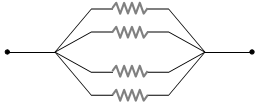
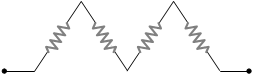
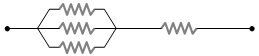
Which arrangement of four identical resistances should be used to draw maximum energy from a cell of voltage V

(a)

(b)

(c)

(d)