Question
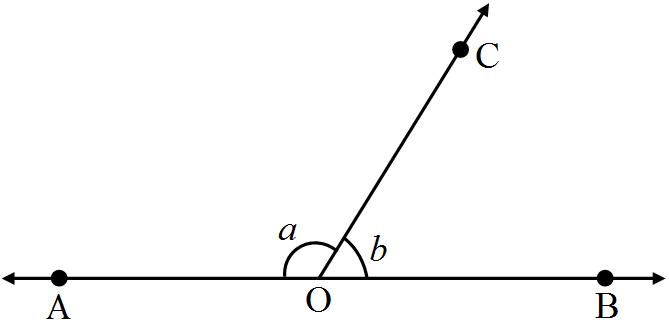
In figure, $\angle\text{AOC}$ and $\angle\text{BOC}$ from a linear pair. If $a - 2b = 30°$, find $a$ and $b.$
Answer

Given that, $\angle AOC$ and $\angle BOC$ form a linear pair If $a - b =30 \angle AOC = a ^{\circ}, \angle BOC = b ^{\circ}$ Therefore, $a + b =180 \ldots$
$(i)$ Given $a -2 b=30$
..$(ii)$ By subtracting
$(i)$ and
$(ii)$
$a+b-a+2 b=180-303 b=150 b=\frac{150}{3} b=50$ Since $a-2 b=$
$30 a-2$(50)$=30 a=30+100 a=130$
Hence, the values of $a$ and $b$ are $130^{\circ}$ and $50^{\circ}$ respectively.

Need a full question paper?

Generate a complete, print-ready paper with questions like this in minutes — across 16+ boards, with answer keys.

Start Generating Free

Similar questions

If $PQRS$ is a square, then write the measure of $\angle\text{SRP.}$
ABCD is a parallelogram, AD is produced to E so that DE = DC and EC produced meets AB produced in F.Prove that BF = BC.
Evaluate: $(-12)^3 + 7^3 + 5^3$​​​​​​​
An umbrella is made by stitching 10 triangular pieces of cloth of two different colours each piece measuring 20cm, 50cm and 50cm. How much cloth of each colour is required for the umbrella?
Draw a histogram to represent the following grouped frequency distribution:
Ages (in years)
Number of teachers
$20-24$
$25-29$
$30-34$
$35-39$
$40-44$
$45-49$
$50-54$
$10$
$28$
$32$
$48$
$50$
$35$
$12$
The diagonals of a rectangle ABCD meet at O, If $\angle\text{BOC}=44^\circ,$ find $\angle\text{OAD}.$
Find the values of $n$ and $\overline{\text{X}}$ in the following case:$\sum\limits^\text{n}_{\text{i}=1}(\text{x}_\text{i}-10)=30$ and $\sum\limits^\text{n}_{\text{i}=1}(\text{x}_\text{i}-6)=150$
Prove that the bisectors of two adjacent supplementary angles include a right angle.
A company selected $2400$ families at random and surveys them to determine a relationship between income level and the number of vehicles in a home. The information gathered is listed in the table below:
Monthly Income
$($in $₹)$
Vechicles Per Family
$0$
$1$
$2$
Above $2$
Less than $7000$
$10$
$160$
$25$
$0$
$7000 – 10000$
$0$
$305$
$27$
$2$
$10000 – 13000$
$1$
$535$
$29$
$25$
$13000 – 16000$
$2$
$469$
$29$
$25$
$16000$ or more
$1$
$579$
$82$
$88$
If a family is chosen, find the probability that the family is:
$1.$ Earning $₹\ 10000 - 13000$ per month and owning exactly $2$ vehicles.
$2$. Earning $₹\ 16000$ or more per month and owning exactly $1$ vehicle.
$3.$ Earning less than $₹ 7000$ per month and does not own any vehicle.
$4.$ Earning $₹ 13000 - 16000$ per month and owning more than $2$ vehicles.
$5.$ Owning not more than $1$ vehicle.
$6.$ Owning at least one vehicle.