MCQ
In forced oscillations, a particle oscillates simple harmonically with a frequency equal to
  • Frequency of driving force
  • B
    Natural frequency of body
  • C
    Difference of frequency of driving force and patural frequency
  • D
    Mean of frequency of driving force and patural frequency

Answer

Correct option: A.
Frequency of driving force
a
(a)

In forced oscillations a particle oscillator simple harmonically with a frequency equal to driving frequency.

Need a full question paper?

Generate a complete, print-ready paper with questions like this in minutes — across 16+ boards, with answer keys.

Start Generating Free

Similar questions

Steam at $100°C$ is passed into $1.1\, kg$ of water contained in a calorimeter of water equivalent $0.02 \,kg$ at $15°C$ till the temperature of the calorimeter and its contents rises to $80°C.$ The mass of the steam condensed in $kg$ is 
During the melting of a slab of ice at $273\, K$ at atmospheric pressure
A car when passes through a convex bridge exerts a force on it which is equal to
$100 \,gm$ of ice at $0°C$ is mixed with $100\, g$ of water at $100°C.$ What will be the final temperature of the mixture .......... $^oC$
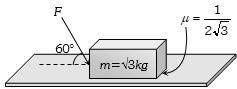
What is the maximum value of the force $F$ such that the block shown in the arrangement, does not move ........ $N$
The equation of a standing wave in a string fixed at both ends is given as $y=2 A \sin k x \cos \omega t$ The amplitude and frequency of a particle vibrating at the mid of an antinode and a node are respectively
The maximum velocity at the lowest point, so that the string just slack at the highest point in a vertical circle of radius $l$
An electric field is applied to a semiconductor. Let the number of charge carriers be $n$ and the average drift speed be $v.$ If the temperature is increased,
A body cools from ${50.0^o}C$ to ${49.9^o}C$ in $5\;s$. How long will it take to cool from ${40.0^o}C$ to ${39.9^o}C$? Assume the temperature of surroundings to be ${30.0^o}C$ and Newton's law of cooling to be valid ....... $\sec$
The angular velocity of rotation of star (of mass $M$ and radius $R$) at which the matter start to escape from its equator will be