In previous problem, if the cell had been connected in parallel (instead of in series) which of the above graphs would have shown the relationship between total current $I$ and $n$?
- A
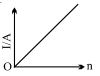
- B

- C

- D
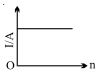
Medium

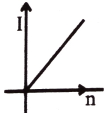

Download our appand get started for free
Experience the future of education. Simply download our apps or reach out to us for more information. Let's shape the future of learning together!No signup needed.*
Similar Questions
- 1At what temperature will the resistance of a copper wire become three times its value at $0\,^oC$ ................. $^oC$ (Temperature coefficient of resistance for copper = $4 × 10^{-3} \,per\, \,^oC$ )View Solution
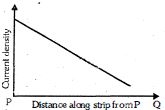
- 2An electric current flows along an insulated strip $PQ$ of a metallic conductor. The current density in the strip varies as shown in graph of figure. Which one of the following statements could explain this variation ?View Solution
- 3Two wires of resistance $R_1$ and $R_2$ have temperature coefficient of resistance ${\alpha _1\,}{\rm{ and \,}}{\alpha _2}$, respectively. These are joined in series. The effective temperature coefficient of resistance isView Solution
- 4For what value of $R$ the net resistance of the circuit will be $18\, ohms$ ............... $\Omega$View Solution
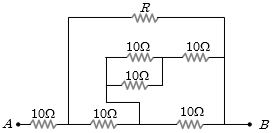
- 5Calculate the equivalent resistance between $A$ and $B$View Solution
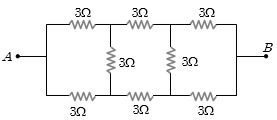
- 6If you are provided a set of resistances $2\, \Omega, 4\, \Omega$ $6\, \Omega$ and $8\, \Omega$. Connect these resistances so as to obtain an equivalent resistance of $\frac{46}{3}\, \Omega$.View Solution
- 7View SolutionWhen a current flows through a conductor its temperature
- 8If you are provided a set of resistances $2\, \Omega, 4\, \Omega$ $6\, \Omega$ and $8\, \Omega$. Connect these resistances so as to obtain an equivalent resistance of $\frac{46}{3}\, \Omega$.View Solution
- 9The current from the battery in the given circuit is ................ $A$View Solution
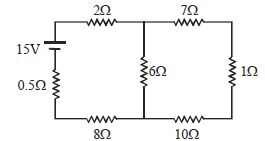
- 10Three resistors each of $2\, ohm$ are connected together in a triangular shape. The resistance between any two vertices will beView Solution