MCQ
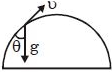
In projectile motion, the modulus of rate of change of velocity
  • is constant
  • B
    first increases then decreases
  • C
    first decreases then increases
  • D
    None of the above

Answer

Correct option: A.
is constant
a
$\frac{d v}{d t}=g=$ constant

Need a full question paper?

Generate a complete, print-ready paper with questions like this in minutes — across 16+ boards, with answer keys.
Start Generating Free

Similar questions

The mass density of a spherical body is given by $\rho \left( r \right) = \frac{k}{r}$ for $r \leq R\,\,$ and $\rho \left( r \right) = 0\,$ for $r > R$ , where $r$ is the distance from the centre. The correct graph that describes qualitatively the acceleration, $a$, of a test particle as a function of $r$ is
An engine giving whistle is moving towards a stationary observer with $110\, m/s$ speed. What will be the ratio of the frequency of the whistle heard when the engine is approaching and receding from the observer ? (Speed of sound $= 330\, m/s$)
If the law of gravitation, instead of being inversesquare law, becomes an inversecube law.
  1. Planets will not have elliptic orbits.
  2. Circular orbits of planets is not possible.
  3. Projectile motion of a stone thrown by hand on the surface of the earth will be approximately parabolic.
  4. There will be no gravitational force inside a spherical shell of uniform density.
A rod of mass $M$ and length $L$ is placed in a horizontal plane with one end hinged about the vertical axis. A horizontal force of $F=\frac {Mg}{2}$ applied at a distance $\frac {5L}{6}$ from the hinged end. The angular acceleration of the rod will be
A force of $98\, N$ is required to just start moving a body of mass $100\, kg$ over ice. The coefficient of static friction is
A couple produces
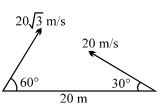
In the figure shown, the two projectiles are fired simultaneously. The minimum distance between them during their flight is  ........ $m$
The position of a particle moving along the $y-$ axis is given as $y = 3t^2 -t^3$ where $y$ is in $metre$ and $t$ is in $second$ . The time when the particle attains maximum positive position will be........$s$
A rectangular block of mass $m$ and area of cross section $A$ floats in a liquid of density $\rho$ If it is given a small vertical displacement from equilibrium, it undergoes oscillations with a time period $T,$ then:
When an object covers equal distances in equal time intervals, then its speed is: