MCQ
In S.H.M. maximum acceleration is at
  • Amplitude
  • B
    Equilibrium
  • C
    Acceleration is constant
  • D
    None of these

Answer

Correct option: A.
Amplitude
a
(a)${A_{\max }} = {\omega ^2}a$

Need a full question paper?

Generate a complete, print-ready paper with questions like this in minutes — across 16+ boards, with answer keys.

Start Generating Free

Similar questions

A hollow cone floats with its axis vertical upto one-third of its height in a liquid of relative density $0.8$ and with its vertex submerged. When another liquid of relative density $\rho$ is filled in it upto one-third of its height, the cone floats upto half its vertical height. The height of the cone is $0.10$ $m$ and the radius of the circular base is $0.05$ $m$. The specific gravity $\rho$ is given by
Following graph shows the correct variation in intensity of heat radiations by black body and frequency at a fixed temperature
The molecules of a given mass of a gas have a $r.m.s.$ velocity of $200\, m/sec$ at $27°C$ and $1.0 \times {10^5}\,N/{m^2}$ pressure. When the temperature is $127°C$ and pressure is $0.5 \times {10^5}\,N/{m^2}$, the $r.m.s.$ velocity in $m/sec$ will be
All the particles of a body are situated at a distance R from the origin. The distance of the centre of mass of the body from the origin is:
Consider a body of mass $1.0 \mathrm{~kg}$ at rest at the origin at time $\mathrm{t}=0$. A force $\overrightarrow{\mathrm{F}}=(\alpha \mathrm{t} \hat{\mathrm{i}}+\beta \hat{\mathrm{j}})$ is applied on the body, where $\alpha=1.0 \mathrm{Ns}^{-1}$ and $\beta=1.0 \mathrm{~N}$. The torque acting on the body about the origin at time $\mathrm{t}=1.0 \mathrm{~S}$ is $\vec{\tau}$. Which of the following statements is (are) true?

$(A)$ $|\vec{\tau}|=\frac{1}{3} \mathrm{Nm}$

$(B)$ The torque $\vec{\tau}$ is in the direction of the unit vector $+\hat{\mathrm{k}}$

$(C)$ The velocity of the body at $\mathrm{t}=1$ is $\overrightarrow{\mathrm{v}}=\frac{1}{2}(\hat{\mathrm{i}}+2 \hat{\mathrm{j}}) \mathrm{m} \mathrm{s}^{-1}$

$(D)$ The magnitude of displacement of the body at $\mathrm{t}=1 \mathrm{~s}$ is $\frac{1}{6} \mathrm{~m}$
A particle is projected vertically upwards from $O$ with velocity $v$ and a second particle is projected at the same instant from $P$ (at a height h above $O$) with velocity $v$ at an angle of projection $\theta$ . The time when the distance between them is minimum is
When water droplets merge to form a bigger drop:
  1. Energy is liberated.
  2. Energy is absorbed.
  3. Energy is neither liberated nor absobred.
  4. Energy may either be liberated or absorbed depending on the nature of the liquid.
Equation of plane wave is $y=4 \sin \frac{\pi}{4}\left[2 t+\frac{x}{8}\right]$
The phase difference at any given instant of two particles 16 cm apart is
Two samples A and B are initially kept in the same state. Sample A is expanded through an adiabatic process and the sample B through an isothermal process. The final volumes of the samples are the same. The final pressures in A and B are pA and prespectively.
  1. pA > pB
  2. pA = pB
  3. pA < pB
  4. The relation between pA and pB cannot be deduced.
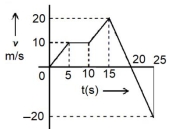
From the $v$ - $t$ graph shown. the ratio of distance to displacement in $25\,s$ of motion