Question
In single slit diffraction, explain why the maxima at $\theta=\left(n+\frac{1}{2}\right)\left(\frac{\lambda}{a}\right)$ becomes weaker and weaker as an increases. State two important differences between interference and diffraction pattern.

Answer

As n increases. deviation of light from straight direction increases thus the light spread out more and which result in decreasing intensity of bright fringes.
In interference pattern the fringes are of equal width (dark and bright) and are of equal intensity and in diffraction the central maxima is brightest and its width is wider twice as compare to the other maxima and intensity of bands goes on decreasing as we move away from the Centre.

Need a full question paper?

Generate a complete, print-ready paper with questions like this in minutes — across 16+ boards, with answer keys.
Start Generating Free

Similar questions

The momentum p of a particle changes with time t according to the relation $\frac{\text{dp}}{\text{dt}}=(10\text{N})+(2\text{N/s)t}.$ If the momentum is zero at t = 0, what will the momentum be at t = 10s?
A mosquito is sitting on an $L.P.$ record disc rotating on a turn table at $33\frac{1}{3}$ revolutions per minute. The distance of the mosquito from the centre of the turn table is $10\ cm$. Show that the friction coefficient between the record and the mosquito is greater than $\frac{\pi^2}{81}.$ Take $g =10 m/s^2.$
Explain, with the help of a nuclear reaction in each of the following cases, how the neutron to proton ratio changes during (i) alpha-decay (ii) beta-decay?
A difference of $2.3\ eV$ separates two energy levels in an atom. What is the frequency of radiation emitted when the atom make a transition from the upper level to the lower level?
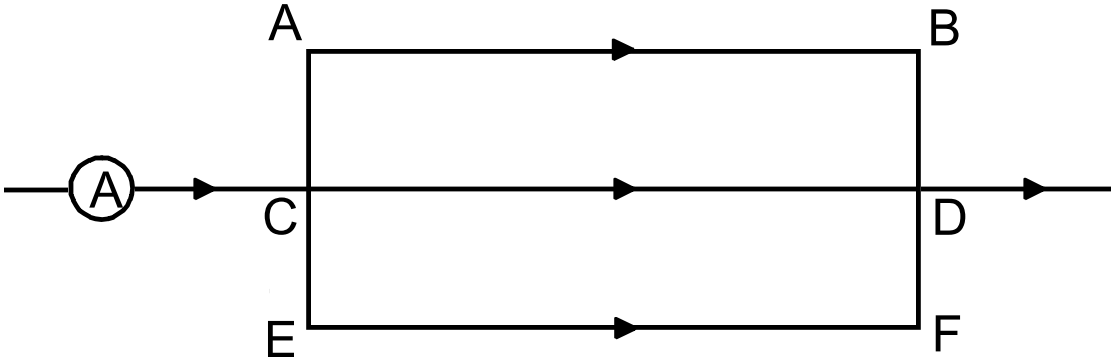
Figure shows a part of an electric circuit. The wires $AB, CD$ and $EF$ are long and have identical resistances. The separation between the neighbouring wires is $1.0\ cm.$ The wires $AE$ and $BF$ have negligible resistance and the ammeter reads $30A.$ Calculate the magnetic force per unit length of $AB$ and $CD.$
Derive the formula for the force acting on current carrying rod placed in a magnetic field.
Derive an expression for the axial magnetic field of a finite solenoid of length 2l and radius r carrying current I. Under what condition does the field become equivalent to that produced by a bar magnet?
  1. Using de Broglie's hypothesis, explain with the help of a suitable diagram, Bohr's second postulate of quantization of energy levels in a hydrogen atom.
  2. The ground state energy of hydrogen atom is - 13.6 eV. What are the kinetic and potential energies of the electron in this state?
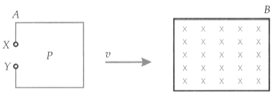
A rectangular coil P is moved from a point A to another point B with uniform velocity 'v' through a region of a uniform magnetic field acting normally inwards as shown in the figure. Show graphically (i) the variation of magnetic flux associated with the coil with time, (ii) the variation of induced emf across points X and Y of the coil with time. 
Image

Explain the nature of variation in magnetic flux as represented by the graph in the first case.
Write two properties and two uses of X-rays.