MCQ
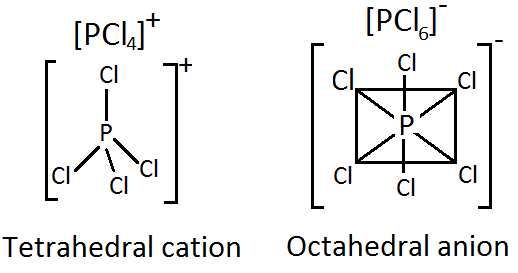
In solid state $\ce{PCl_5}$ is a _________.
- ACovalent solid.
- BOctahedral structure.
- CIonic solid with $\ce{[PCl_6]^+}$ octahedral and $\ce{[PCl_4]^-}$ tetrahedra.
- ✓Ionic solid with $\ce{[PCl_4]^+}$ tetrahedral and $\ce{[PCl_6]^-}$ octahedra.
Generate a complete, print-ready paper with questions like this in minutes — across 16+ boards, with answer keys.
$Image$
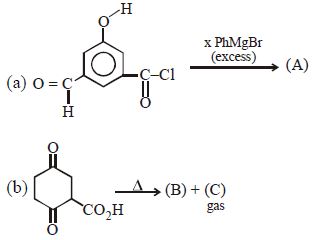
In this reaction, $\mathrm{RCONHBr}$ is formed from which this reaction has derived its name. Electron donating group at phenyl activates the reaction. Hofmann degradation reaction is an intramolecular reaction.
$1.$ How can the conversion of $(i)$ to $(ii)$ be brought about?
$(A)$ $\mathrm{KBr}$ $(B)$ $\mathrm{KBr}+\mathrm{CH}_3 \mathrm{ONa}$ $(C)$ $\mathrm{KBr}+\mathrm{KOH}$ $(D)$ $\mathrm{Br}_2+\mathrm{KOH}$
$2.$ Which is the rate determining step in Hofmann bromamide degradation?
$(A)$ Formation of $(i)$ $(B)$ Formation of $(ii)$ $(C)$ Formation of $(iii)$ $(D)$ Formation of $(iv)$
$3.$ What are the constituent amines formed when the mixture of $(i)$ and $(ii)$ undergoes Hofmann bromamide degradation?
$Image$
give the answer question $1$, $2$, and $3.$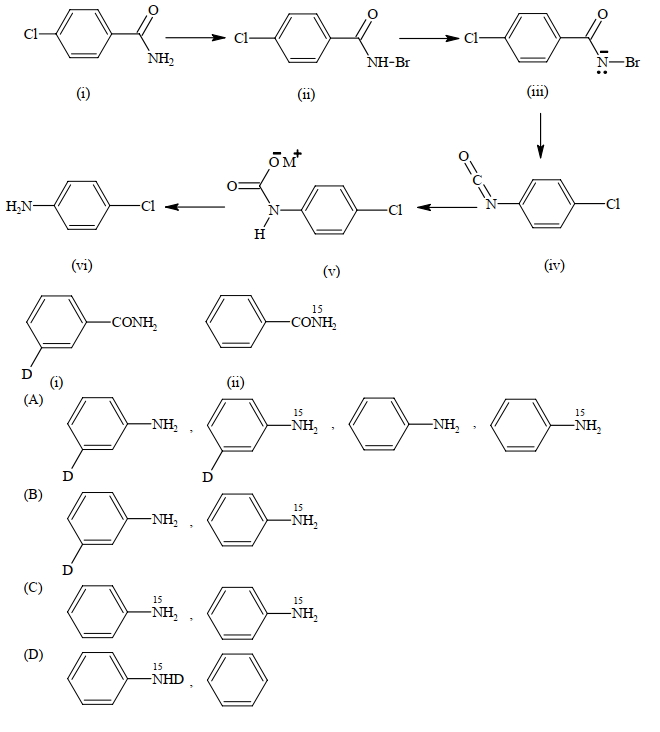
$CH_3CH_2OH$ $\xrightarrow{{P + {I_2}}}A\xrightarrow[{{\text{dry ether}}}]{{Mg}}B\xrightarrow{{HCHO}}C\xrightarrow{{{H_2}O}}D$ the compound $D$ is