MCQ
In sum and difference method in vibration magnetometer, the time period is more if
  • A
    Similar poles of both magnets are on same sides
  • Opposite poles of both magnets are on same sides
  • C
    Both magnets are perpendicular to each other
  • D
    Nothing can be said

Answer

Correct option: B.
Opposite poles of both magnets are on same sides
b
(b)In sum position : ${T_S} = 2\pi \sqrt {\frac{{{I_s}}}{{({M_1} + {M_2}){B_H}}}} $
In difference position : ${T_d} = 2\pi \sqrt {\frac{{{I_d}}}{{({M_1} - {M_2}){B_H}}}} $
It is clear that ${T_d} > {T_s}$

Need a full question paper?

Generate a complete, print-ready paper with questions like this in minutes — across 16+ boards, with answer keys.

Start Generating Free

Similar questions

A person blows into open-end of a long pipe. As a result, a high-pressure pulse of air travels down the pipe. When this pulse reaches the other end of the pipe.

$(A)$ a high-pressure pulse starts traveling up the pipe, if the other end of the pipe is open.

$(B)$ a low-pressure pulse starts traveling up the pipe, if the other end of the pipe is open.

$(C)$ a low-pressure pulse starts traveling up the pipe, if the other end of the pipe is closed.

$(D)$ a high-pressure pulse starts traveling up the pipe, if the other end of the pipe is closed.
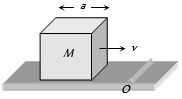
A cubical block of side $a$ is moving with velocity $v$ on a horizontal smooth plane as shown. It hits a ridge at point $O$. The angular speed of the block after it hits $O$ is 
Suppose the drift velocity $v_d$ in a material varied with the applied electric field $E$ as ${v_d}\, \propto \,\sqrt E $ .Then $V - I$ graph for a wire made of such a material is best given by
An unknown transistor needs to be identified as a $npn$  or  $pnp$ type. A multimeter, with $+ve$ and $-ve$  terminals, is used to measure resistance between different terminals of transistor. If terminal $2$ is the base of the transistor then which of the following is correct for a $pnp$ transistor?
If $50$ joule of work must be done to move an electric charge of $2 \,C$ from a point, where potential is $-10$ volt to another point, where potential is $V$ volt, the value of $V$ is ......... $V$
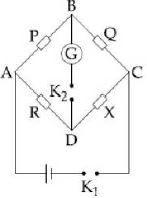
In a Wheatstone bridge (see figure) Resistance $P$ and $Q$ are approximately equal. When $R = 400\,\Omega ,$ the bridge is balanced. On interchanging $P$ and $Q,$ the value of $R,$ for balance is $405\,\Omega .$ The value of $X$ is close to ................. $ohm$
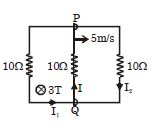
A rectangular loop has a sliding connector $PQ$ of length $2\ m$ and resistance $10\Omega $ and it is moving with a speed $5\ m/s$ as shown. The set-up is placed in a uniform magnetic field $3T$ going into the plane of the paper. The three currents $I_1$ , $I_2$ and $I$ are 
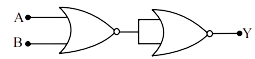
In the following circuit, the output $Y$ for all possible inputs $A$ and $B$ is expressed by the truth table.
The $PE$ of a $2 \,kg$ particle, free to move along $x$-axis is given by $V(x)=\left(\frac{x^3}{3}-\frac{x^2}{2}\right) \,J$. The total mechanical energy of the particle is $4 \,J$. Maximum speed (in $ms ^{-1}$ ) is ...........
The relative velocity of two consecutive layers is 8 cm/s. If the perpendicular distance between the layers is $0.1\, cm$, then the velocity gradient will be ......... $sec^{-1}$