MCQ
In the above reaction $o/p$ ratio will be highest when
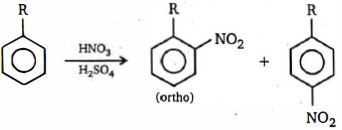
  • $R = - CH_3$
  • B
    $R = - CH_2 -CH_3$
  • C
    $R = - CHMe_2$
  • D
    $R = - CMe_3$

Answer

Correct option: A.
$R = - CH_3$
a
$(a)$ The steric demand of $H^{\ominus}$  is, however extremely small, and  when attack on $C_6H_5Y$ is by any other electrophile, $E^{\oplus}$ , which  will necessarily be larger, there will be increasing interaction between $E$ and $Y$ in the transition state for attack at the position $o-$ to $Y (57 \,b, R = E)$  as attacking electrophile and substituent increase in size ; there can be no such interaction in the transition state for $p-$ attack $(57a, R = E)$. This will  be reflected in an increasing $\Delta \,G^+$ for $o-$ attack, a consequently  slower reaction, and the relative proportion of $o-$ product will thus fall as the  size of $E$ and / or $Y$ increase. This is illustrated by the falling $f_{o^-} /f_{p^-}$ ratios which are  observed for the nitration of alkylbenzenes $(Y ---CH_3 \to CMe_3)$ under comparable conditions ; 

Increase in size of $Y$ $\begin{gathered}
   \downarrow  \hfill \\
   \downarrow  \hfill \\
   \downarrow  \hfill \\
   \downarrow  \hfill \\
   \downarrow  \hfill \\ 
\end{gathered} $ $\begin{array}{*{20}{c}}
  Y&{\% \,\,o - }&{\% \,p\, - } \\ 
  {C{H_3}}&{58}&{37} \\ 
  {C{H_2}Me}&{45}&{49} \\ 
  {CHM{e_2}}&{30}&{62} \\ 
  {CM{e_3}}&{16}&{73} 
\end{array}$

Need a full question paper?

Generate a complete, print-ready paper with questions like this in minutes — across 16+ boards, with answer keys.

Start Generating Free

Similar questions

In thermodynamics, a process is called reversible when
In which of the following arrangements, the order is $NOT$ according to the property indicated against it?
The chemical properties of any element depend on which of the following factor?
When the value of the principal quantum number $n$ is $3$, the permitted values of the azimuthal quantum numbers $l$ and the magnetic quantum numbers $m$ , are $l$$m$

            $l$                       $m$

The element having very high ionization enthalpy but zero electron affinity is
Given below are two statements: one is labelled as Assertion $(A)$ and the other is labelled as Reason $(R)$

Assertion $(A) :$ At $10^{\circ} C$, the density of a $5\, M$ solution of $KCl$ [atomic masses of $K$ and $Cl$ are $39$ and $35.5\, g \,mol ^{-1}$ ]. The solution is cooled to $-21^{\circ} C$. The molality of the solution will remain unchanged.

Reason $(R):$ The molality of a solution does not change with temperature as mass remains unaffected with temperature.

In the light of the above statements, choose the correct answer from the options given below

Which is most stable cation
The number of $Cl^-$ ion in $333\, g$ anhydrous $CaCl_2$ will be ................ $\mathrm{N_A}$
The ratio of area covered by second orbital to the first orbital is
$50\, mL$ of $0.5\, M$ oxalic acid is needed to neutralize $25\, ml$ of sodium hydroxide solution. The amount ....... gram of $NaOH$ in $50\, mL$ of the given sodium hydroxide solution is