Question
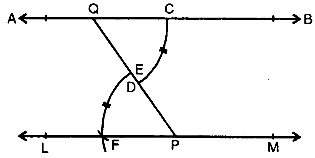
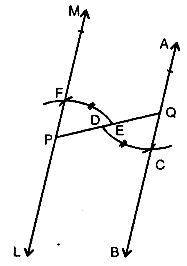
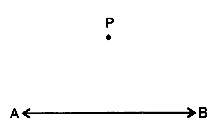
In the case, given below, draw a line through point $P$ and parallel to $A B:$
Answer

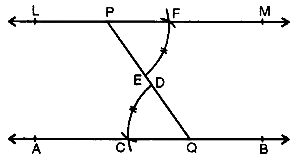
Steps of construction:
(i) From $P$ draw a line segment meeting at $A B$
(ii) With centre $Q$ and some suitable radius draw an arc $C D$.
(iii) With centre $P$ and the same radius draw another arc meeting $P Q$ at $E$.

(iv) With centre $E$ and radius equal to $C D$, cut this arc at $F$

(v) Join PF and produce it to both sides to $L$ and $M$. Then line $LM$ is parallel to given line $A B$.

Need a full question paper?

Generate a complete, print-ready paper with questions like this in minutes — across 16+ boards, with answer keys.
Start Generating Free

Similar questions

By selling an article for ₹825, a man loses equal to j of its selling price. Find:
(i) the cost price of the article,
(ii) the profit percent or the loss percent made, if the same article is sold for ₹ 1265.
Construct an isosceles Δ ABC such that:
Base AB = 6.2 cm and base angle = 45°. Measure the other two sides of the triangle.
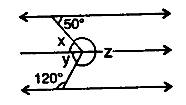
In the given figure, the directed lines are parallel to each other. Find the unknown angles.

The marks obtained by 40 students of a class are given below:
80, 10, 30, 70, 60, 50, 50, 40, 40, 20, 40, 90, 50, 30, 70, 10, 60, 50, 20, 70, 70, 30, 80, 40,20, 80, 90, 50, 80, 60, 70, 40, 50, 60, 90, 60, 40, 40, 60 and 60
(i) Construct a frequency distribution table.
(ii) Find how many students have marks equal to or more than 70?
(iii) How many students obtained marks below 40?
Verify: {(-15) – 8} x -6 = (-15) x (-6) – 8 x (-6)
Evaluate : $\frac{6}{11}-\frac{-3}{4}$
Simplify: $2 \frac{3}{4}-\left[3 \frac{1}{8} \div\left\{5-\left(4 \frac{2}{3}-\frac{11}{12}\right)\right\}\right]$
The daily wages (in ₹) of 100 labourers in a factory are given below :
Daily wages (in ₹) 360280420320400300380
Number of labourers 171018271684
Find the median wages.
From a piece of land, one-third is bought by Rajesh and one-third of remaining is bought by Manoj. If 600 m² land is still left unsold, find the total area of the piece of land.
A shopkeeper buys an article for ₹ 300. He increases its price by 20% and then gives 10% discount on the new price. Find:
(i) the new price (marked price) of the article.
(ii) the discount is given by the shopkeeper.
(iii) the selling price.
(iv) profit percent made by the shopkeeper.