In the circuit shown below, the voltmeter reads $10V.$
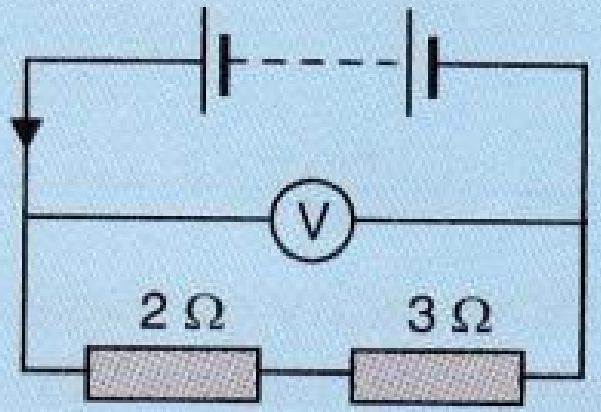
- What is the combined resistance?
- What current flows?
- What is the p.d. across $ 2 Ω$ resistor?
- What is the p.d. across $3 Ω$ resistor?
Download our app for free and get started
$I = 6V$
$\text{R}_1=2\Omega,\text{R}_2=3\Omega$
Combined resistance, $R_{tot} = 2 + 3 = 5$
$\text{I}=\frac{\text{V}}{\text{R}_\text{tot}}=\frac{10}{5}=2\text{A}$
p.d. across $2\Omega$ resistor $= I \times R_1 = 2 \times 2 = 4V.$
p.d. across $3\Omega$ resistor $= I \times R_2 = 2 \times 3 = 6V.$
$\text{R}_1=2\Omega,\text{R}_2=3\Omega$
Combined resistance, $R_{tot} = 2 + 3 = 5$
$\text{I}=\frac{\text{V}}{\text{R}_\text{tot}}=\frac{10}{5}=2\text{A}$
p.d. across $2\Omega$ resistor $= I \times R_1 = 2 \times 2 = 4V.$
p.d. across $3\Omega$ resistor $= I \times R_2 = 2 \times 3 = 6V.$

Download our appand get started for free
Experience the future of education. Simply download our apps or reach out to us for more information. Let's shape the future of learning together!No signup needed.*
Similar Questions
- 1View SolutionTen bulbs are connected in a series circuit to a power supply line. Ten identical bulbs are connected in a Parallel circuit to an identical power supply line.
- Which circuit would have the highest voltage across each bulb?
- In which circuit would the bulbs be brighter?
- In which circuit, if one bulb blows out, all others will stop glowing
- Which circuit would have less current in it?
- 2Calculate the area of cross-section of a wire if its length is 1.0m, its resistance is $23 Ω$ and the resistivity of the material of the wire is $1.84\times10 Ω\ \text{m}.$View Solution
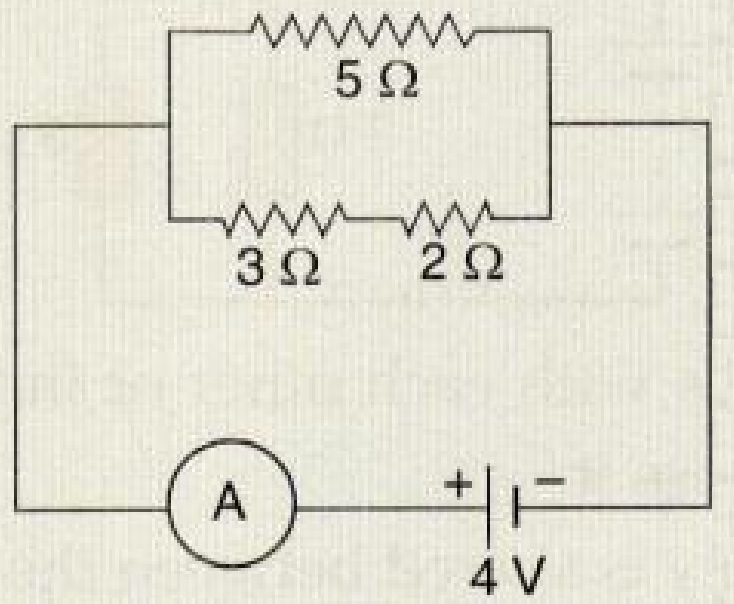
- 3With the help of a circuit diagram, obtain the relation for the equivalent resistance of two resistances connected in parallel. In the circuit diagram shown below, find:View Solution
- Total resistance.
- Current shown by the ammeter $A$
- 4View SolutionWhat would be the effect on the resistance of a metal wire of:
- Increasing its length?
- Increasing its diameter?
- Increasing its temperature?
- 5The electrical resistivities of three materials P, Q and R are given below:$\begin{matrix}\text{P}&2.3\times10^{3}\Omega\text{ m}\\\text{Q}&2.63\times10^{-8}\Omega\text{ m}\\\text{R}&1.0\times10^{15}\Omega\text{ m}\end{matrix}$View Solution
Which material will you use for making:- Electric wires.
- Handle for soldering iron, and
- Solar cells?
- 6View SolutionState and explain Joule’s law of heating.
- 7The electrical resistivities of four materials $A, B, C$ and $D$ are given below:View Solution
$\text{A}\ -110\times10^{-8}\Omega\text{ m}$
$\text{B}-\ 1.0\times10^{10}\Omega\text{ m}$
$\text{C}-\ 10.0\times10^{-8}\Omega\text{ m}$
$\text{D}-\ 2.3\times10^{3}\Omega\text{ m}$
Which material is:- Good conductor.
- Resistor.
- Insulator, and
- Semiconductor
- 8When a current of $4.0A$ passes through a certain resistor for $10$ minutes,$ 2.88 \times 10J$ of heat are produced. Calculate:View Solution
- The power of the resistor.
- The voltage across the resistor.
- 9View SolutionGive three reasons why different electrical appliances in a domestic circuit are connected in parallel.
- 10View SolutionCalculate the cost of operating a heater of 500W for 20hours at the rate of? ₹3.90 per unit.