With the help of a circuit diagram, obtain the relation for the equivalent resistance of two resistances connected in parallel. In the circuit diagram shown below, find:
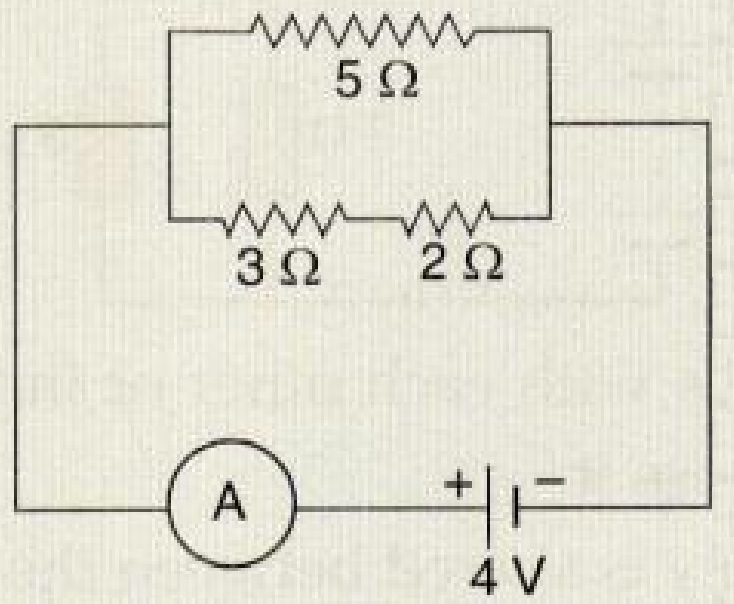
- Total resistance.
- Current shown by the ammeter $A$
Download our app for free and get started
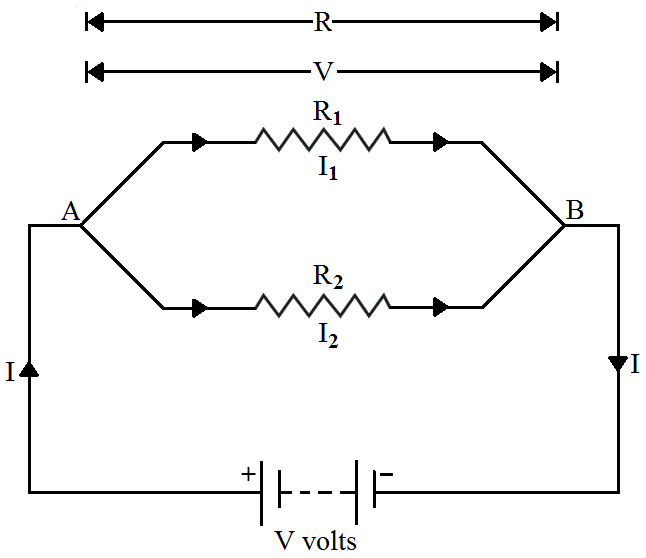
- Suppose total current flowing the circuit is I then the current passing through resistance $R_1 $ will be $I_1$ and current passing through resistance $R_2$ will be $I_2$
Let resultant resistance of this parallel combination is R. By applying the ohm's law to each resistance we get that,
$\text{I}_1=\frac{\text{V}}{\text{R}_1}$
$\text{I}_2=\frac{\text{V}}{\text{R}_2}$
putting these eq in the above one, we get that
$\frac{\text{V}}{\text{R}}=\frac{\text{V}}{\text{R}_1}+\frac{\text{V}}{\text{R}_2}$
$\frac{1}{\text{R}}=\frac{1}{\text{R}_1}+\frac{1}{\text{R}_2}$
If two resistance are connected in parallel than the resultant resistance will be
$\frac{1}{\text{R}}=\frac{1}{\text{R}_1}+\frac{1}{\text{R}_2}$
- Total resistance $= R$
$R_2 = 3 + 2 = 5$ ohms
$R_1 = 5$ ohm
$\frac{1}{\text{R}}=\frac{1}{5}+\frac{1}{5}$
$\frac{1}{\text{R}}=\frac{2}{5}$
$R = 2.5$ ohm
Current flows through the circuit
$\text{I}=\frac{\text{V}}{\text{R}}=\frac{4}{2.5}$
$= 1.6$ amps

Download our appand get started for free
Experience the future of education. Simply download our apps or reach out to us for more information. Let's shape the future of learning together!No signup needed.*
Similar Questions
- 1A wire is 1.0m long, 0.2mm in diameter and has a resistance of $10Ω.$ Calculate the resistivity of its material?View Solution
- 2Calculate the work done in moving a charge of $4$ coulombs from a point at $220$ volts to another point at $230$ volts.View Solution
- 3View SolutionA p.d. of 10V is needed to make a current of 0.02A flow through a wire. What p.d. is needed to make a current of 250mA flow through the same wire?
- 4View SolutionDerive the expression for the heat produced due to a current ‘I’ flowing for a time interval ‘t’ through a resistor ‘R’ having a potential difference ‘V’ across its ends. With which name is this relation known?
- 5View SolutionAn electric heater is connected to the 230V mains supply. A current of 8A flows through the heater.
- How much charge flows around the circuit each second?
- How much energy is transferred to the heater each second?
- 6If the charge on an electron is $1.6 \times 10$ coulombs, how many electrons should pass through a conductor in $1$ second to constitute $1$ ampere current?View Solution
- 7Two resistances when connected in parallel give resultant value of $2$ ohm; when connected in series the value becomes $9$ ohm. Calculate the value of each resistance.View Solution
- 8View SolutionDistinguish between resistance and resistivity.
- 9View SolutionConsider the circuit given below where A, B and C are three identical light bulbs of constant resistance.
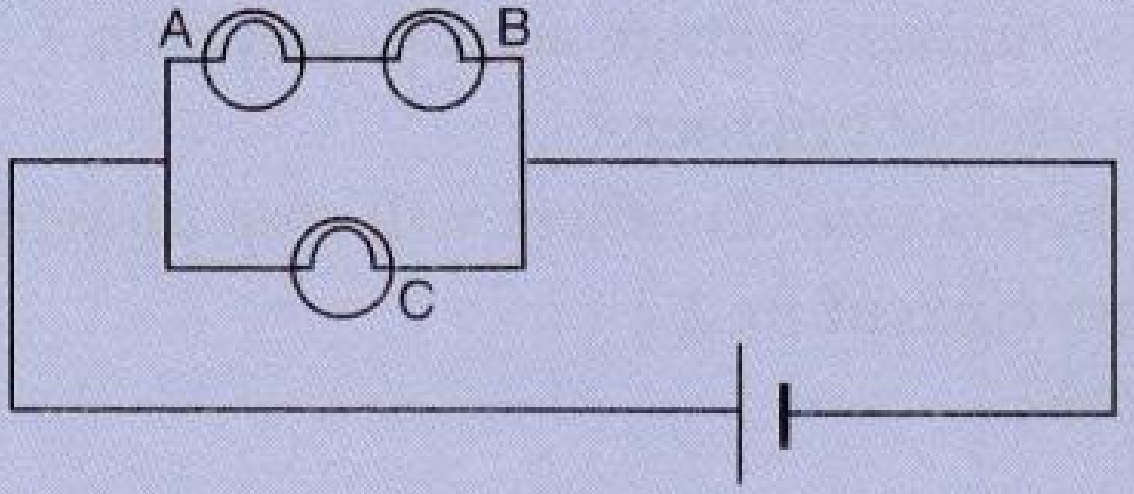
- List the bulbs in order of increasing brightness.
- If C burns out, what will be the brightness of A now compared with before?
- If B burns out instead, what will be the brightness of A and C compared with before?
- 10View SolutionWhat is a circuit diagram? Draw the labelled diagram of an electric circuit comprising of a cell, a resistor, an ammeter, a voltmeter and a closed switch (or closed plug key). Which of the two has a large resistance: an ammeter or a voltmeter?