The magnitude of electric field $E$ in the annular region of a charged cylindrical capacitor
IIT 1996, Easy
Download our app for free and get started
(c) The magnitude of electric field in the annular region of a charged cylindrical capacitor is given by $E = \frac{1}{{2\pi {\varepsilon _0}}}\frac{\lambda }{r}$ where $\lambda$ is the charge per unit length and $r$ is the distance from the axis of the cylinder. Thus $E \propto \frac{1}{r}$

Download our appand get started for free
Experience the future of education. Simply download our apps or reach out to us for more information. Let's shape the future of learning together!No signup needed.*
Similar Questions
- 1A capacitor $4\,\mu F$ charged to $50\, V$ is connected to another capacitor of $2\,\mu F$ charged to $100 \,V$ with plates of like charges connected together. The total energy before and after connection in multiples of $({10^{ - 2}}\,J)$ isView Solution
- 2$64$ drops each having the capacity $C$ and potential $V$ are combined to form a big drop. If the charge on the small drop is $q$, then the charge on the big drop will beView Solution
- 3A solid conducting sphere having a charge $Q$ is surrounded by an uncharged concentric conducting hollow spherical shell. Let the potential difference between the surface of the solid sphere and that of the outer surface of the hollow shell be $V$. If the shell is now given a charge of $-3Q$, the new potential difference between the same two surfaces is......$V$View Solution
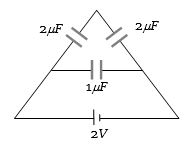
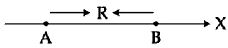
- 4Two electric dipoles $A, B$ with respective dipole moments $\overrightarrow {{d_A}} = - 4\,qa\,\hat i$ and $\overrightarrow {{d_B}} = 2\,qa\,\hat i$ are placed on the $x-$ axis with a separation $R$, as shown in the figure. The distance from $A$ at which both of them produce the same potential isView Solution
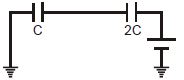
- 5In the circuit shown in figure battery is $10 \ V$ and $C = 6\,\mu F$ . The charge stored in capacitor of capacity $C$ is......$\mu C$View Solution
- 6Three charges $-q, Q$ and $-q$ are placed respectively at equal distances on a straight line. If the potential energy of the system of three charges is zero, then what is the ratio of $Q: q$ ?View Solution
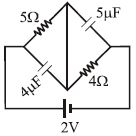
- 7Find the ratio of energy stored in $5\,\mu F$ and $4\,\mu F$ capacitor in the given circuit in steady stateView Solution
- 8The capacity of a condenser in which a dielectric of dielectric constant $5$ has been used, is $C$. If the dielectric is replaced by another with dielectric constant $20$, the capacity will becomeView Solution
- 9Following operations can be performed on a capacitor : $X$ - connect the capacitor to a battery of $emf$ $E.$ $Y$ - disconnect the battery $Z$ - reconnect the battery with polarity reversed. $W$ - insert a dielectric slab in the capacitorView Solution
- 10The charge on any one of the $2\,\mu \,F$ capacitors and $1\,\mu \,F$ capacitor will be given respectively (in $\mu \,C$) asView Solution