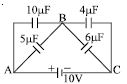
In the circuit shown in figure, four capacitors are connected to a battery. The equivalent capacitance of the circuit is......$ \mu F$
Medium


Download our appand get started for free
Experience the future of education. Simply download our apps or reach out to us for more information. Let's shape the future of learning together!No signup needed.*
Similar Questions
- 1A proton has a mass $1.67 \times 10^{-27} \,kg$ and charge $+1.6 \times 10^{-19} \,C$. If the proton is accelerated through a potential difference of million volts, then the kinetic energy is ......... $J$View Solution
- 2Two plates are at potentials $-10\, V$ and $+30\, V$. If the separation between the plates be $2\, cm$. The electric field between them is.......$V/m$View Solution
- 3A parallel plate capacitor has a capacity $C$. The separation between the plates is doubled and a dielectric medium is introduced between the plates. If the capacity now becomes $2C$, the dielectric constant of the medium isView Solution
- 4View SolutionIn a charged capacitor, the energy resides
- 5An arc of radius $r$ carries charge. The linear density of charge is $\lambda$ and the arc subtends a angle $\frac{\pi }{3}$ at the centre. What is electric potential at the centreView Solution
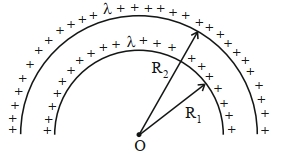
- 6Charge of $2Q$ and $-Q$ are placed on two plates of a parallel plate capacitor. If capacitance of capacitor is $C$, potential difference between the plates isView Solution
- 7A charge $+q$ is distributed over a thin ring of radius $r$ with line charge density $\lambda=q \sin ^{2} \theta /(\pi r)$. Note that the ring is in the $X Y$ - plane and $\theta$ is the angle made by $r$ with the $X$-axis. The work done by the electric force in displacing a point charge $+ Q$ from the centre of the ring to infinity isView Solution
- 8On moving a charge of $20$ coulombs by $2 \;cm , 2 \;J$ of work is done, then the potential difference between the points is (in $volt$)View Solution
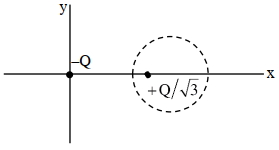
- 9Two point charges $-Q$ and $+Q / \sqrt{3}$ are placed in the xy-plane at the origin $(0,0)$ and a point $(2,0)$, respectively, as shown in the figure. This results in an equipotential circle of radius $R$ and potential $V =0$ in the $xy$-plane with its center at $(b, 0)$. All lengths are measured in meters.View Solution
($1$) The value of $R$ is. . . . meter.
($2$) The value of $b$ is. . . . . .meter.
- 10The electric potential at the centre of two concentric half rings of radii $R_1$ and $R_2$, having same linear charge density $\lambda$ isView Solution