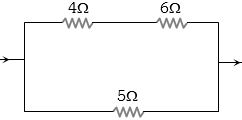
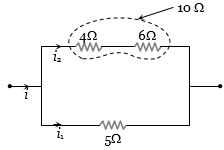
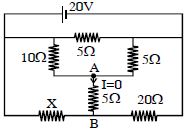
In the circuit shown in figure, the heat produced in $5\, ohm $ resistance is $10\, cal / sec$ . The heat produced in $4$ resistance is ................ $cal /sec$
IIT 1981, Medium


Download our appand get started for free
Experience the future of education. Simply download our apps or reach out to us for more information. Let's shape the future of learning together!No signup needed.*
Similar Questions
- 1Space between two concentric conducting spheres of radii $a$ and $b (b > a)$ is filled with $a$ medium of resistivity $\rho $. The resistance between the two spheres will beView Solution
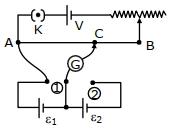
- 2In the given potentiometer circuit arrangement, the balancing length ${AC}$ is measured to be $250$ ${cm}$. When the galvanometer connection is shifted from point $(1)$ to point $(2)$ in the given diagram, the balancing length becomes $400\, {cm}$. The ratio of the emf of two cells, $\frac{\varepsilon_{1}}{\varepsilon_{2}}$ is -View Solution
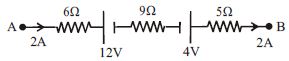
- 3The potential difference between $A$ and $B$ in the Figure is .............. $V$View Solution
- 4A wire of resistance $R_{1}$ is drawn out so that its length is increased by twice of its original length.The ratio of new resistance to original resistance is.View Solution
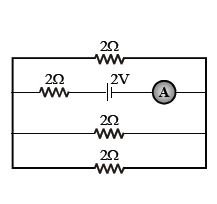
- 5View SolutionThe reading of the ammeter as shown in figure
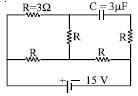
- 6In the circuit shown, the cell is ideal, with $emf$ $=$ $15$ $V$. Each resistance is of $3 $ $\Omega$ . The potential difference across the capacitor is.....$V$View Solution
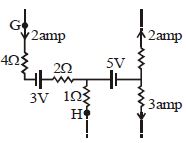
- 7In the part of a circuit shown in the figure, the potential difference $(V_G -V_H)$ between points $G$ and $H$ will be ............... $V$View Solution
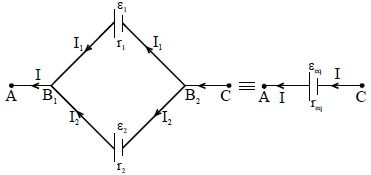
- 8Consider a parallel combination of the cellsshown in the figure.The potential difference in between $B_1$ and $B_2$ isView Solution
- 9In given circuit current through $AB$ is zero, then what will be the value of unknown resistance $'X'$ ............... $\Omega$View Solution
- 10A student measures the terminal potential difference $(V)$ of a cell $($ of $emf \;\varepsilon $ and internal resistance $r)$ as a function of the current $(I)$ flowing through it. The slope, and intercept, of the graph between $V$ and $I$, then, respectively, equalView Solution