In the circuit shown in the figure below, which of the following statement is incorrect ?
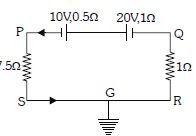
Medium

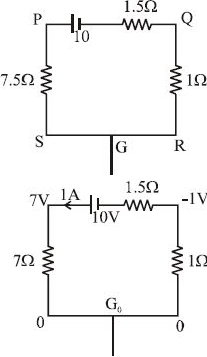

Download our appand get started for free
Experience the future of education. Simply download our apps or reach out to us for more information. Let's shape the future of learning together!No signup needed.*
Similar Questions
- 1Two conductors are made of the same material and have the same length. Conductor $A$ is a solid wire of diameter $1.0\, mm$. Conductor $B$ is a hollow tube of outside diameter $2.0\, mm$ and inside diameter $1.0\, mm$. The resistance ratio $R_A/R_B$ will beView Solution
- 2In the given circuit the current $I_1$ is .............. $A$View Solution
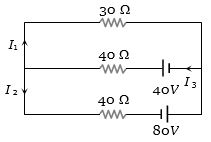
- 3Two current elements $P$ and $Q$ have current voltage characteristics as shown below :View Solution
Which of the graphs given below represents current voltage characteristics when $P$ and $Q$ are in series.
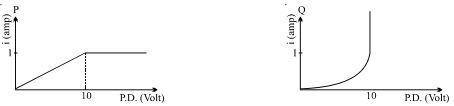
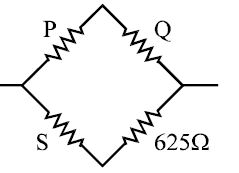
- 4$A$ Wheatstone's bridge is balanced with a resistance of $625\, \Omega$ in the third arm, where $P, Q$ and $S$ are in the $1^{st}, 2^{nd}$ and $4^{th}$ arm respectively. If $P$ and $Q$ are interchanged, the resistance in the third arm has to be increased by $51\,\Omega$ to secure balance. The unknown resistance in the fourth arm is ............. $\Omega$View Solution
- 5If an electron revolves in the path of a circle of radius of $0.5 × 10^{-10}\, m$ at frequency of $5 × 10^{15}$ $cycles/s$ the electric current in the circle is ..................$mA$ (Charge of an electron $=1.6 × 10^{-19}\, C$ )View Solution
- 6Give colors of the ring in sequence marked on a resistance of $56 \ k\Omega$ with tolerance $\pm 5\%$View Solution
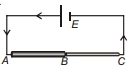
- 7In the following diagram, the lengths of wires $A B$ and $B C$ are equal, but the radius of wire $A B$ is double that of $B C$. The ratio of potential gradient on wires $A B$ and on $B C$ will be (wires are made of same material)View Solution
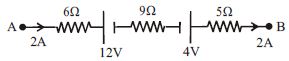
- 8The potential difference between $A$ and $B$ in the Figure is .............. $V$View Solution
- 9View SolutionIn the experiment of potentiometer, at balance, there is no current in the
- 10An electric bulb is rated $220\, volt$ and $100\, watt$. Power consumed by it when operated on $110\, volt$ is ............. $watt$View Solution