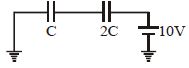
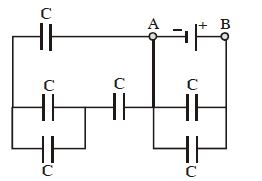
In the circuit shown in the figure, $C = 6\,\mu F$. The charge stored in the capacitor of capacity $C$ is..........$\mu C$
Medium
Download our app for free and get started
$0-\frac{Q}{C}+10-\frac{Q}{2 C}=0$
$Q=\frac{20 C}{3}=\frac{20 \times 6}{3}=40 \mu C$

Download our appand get started for free
Experience the future of education. Simply download our apps or reach out to us for more information. Let's shape the future of learning together!No signup needed.*
Similar Questions
- 1View SolutionOn increasing the plate separation of a charged condenser, the energy
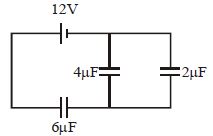
- 2The charge deposited on $4\,\mu F$ capacitor in the circuit isView Solution
- 3Electric charges of $ + 10\,\mu C,\; + 5\,\mu C,\; - 3\,\mu C$ and $ + 8\,\mu C$ are placed at the corners of a square of side $\sqrt 2 \,m$. the potential at the centre of the square isView Solution
- 4Two opposite and equal charges $4 \times {10^{ - 8}}\,coulomb$ when placed $2 \times {10^{ - 2}}\,cm$ away, form a dipole. If this dipole is placed in an external electric field $4 \times {10^8}\,newton/coulomb$, the value of maximum torque and the work done in rotating it through $180^\circ $ will beView Solution
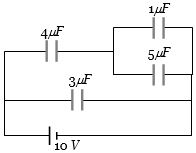
- 5The charge on $4\, \mu F$ capacitor in the given circuit is .... in $\mu C$View Solution
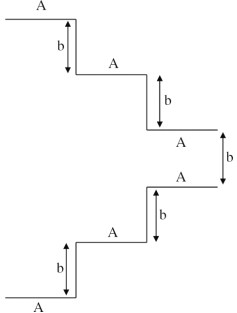
- 6A paralle plate capacitor is made up of stair like structure with a palte area $A$ of each stair and that is connected with a wire of length $b$, as shown in the figure. The capacitance of the arrangement is $\frac{ x }{15} \frac{\varepsilon_{0} A }{ b }$. The value of $x$ is ............View Solution
- 7The capacity of a parallel plate condenser is $15\,\mu \,F$, when the distance between its plates is $6 \,cm$. If the distance between the plates is reduced to $2\, cm$, then the capacity of this parallel plate condenser will be......$\mu \,F$View Solution
- 8Find equivalent capacitance between $A$ and $B$View Solution
- 9A hollow metal sphere of radius $5\, cm$ is charged so that the potential on its surface is $10\, V$. The potential at the centre of the sphere isView Solution
- 10Two identical capacitors, have the same capacitance $C$. One of them is charged to potential $V_1$ and the other to $V_2$. The negative ends of the capacitors are connected together. When the positive ends are also connected, the decrease in energy of the combined system isView Solution