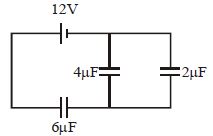
The charge deposited on $4\,\mu F$ capacitor in the circuit is
Medium
Download our app for free and get started
$6 \mu \mathrm{F}$ and $6 \mu \mathrm{F}$ are in series
$\therefore$ Voltage ascross $4 \mu \mathrm{F}=6 \mathrm{V}$
$\therefore Q=6 \times 4 \times 10^{-6}$
$=24 \times 10^{-6} \mathrm{C}$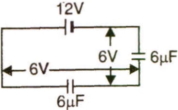

Download our appand get started for free
Experience the future of education. Simply download our apps or reach out to us for more information. Let's shape the future of learning together!No signup needed.*
Similar Questions
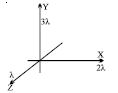
- 1The diagram shows three infinitely long uniform line charges placed on the $X, Y $ and $Z$ axis. The work done in moving a unit positive charge from $(1, 1, 1) $ to $(0, 1, 1) $ is equal toView Solution
- 2The capacitance of a parallel plate capacitor is $12\,\mu \,F$. If the distance between the plates is doubled and area is halved, then new capacitance will be.........$\mu \,F$View Solution
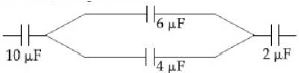
- 3In the figure shown below, the charge on the left plate of the $10\, \mu F$ capacitor is $-30\,\mu C.$ The charge on the right place of the $6\,\mu F$ capacitor is.....$\mu C$View Solution
- 4Charge $q_{2}$ is at the centre of a circular path with radius $r$. Work done in carrying charge $q_{1}$, once around this equipotential path, would beView Solution
- 5View SolutionElectric potential of earth is taken to be zero because earth is a good
- 6An electric charge $10^{-8}\ C$ is placed at the point $ (4\,m, 7\,m, 2\,m)$. At the point $(1\,m, 3\,m, 2\,m)$, the electricView Solution
- 7An infinite number of charges each equal to $0.2\,\mu C$ are arranged in a line at distances $1\,m, 2\,m, 4\,m, 8\,m......$ from a fixed point. The potential at fixed point is ......$kV$View Solution
- 8View SolutionSome charge is being given to a conductor. Then its potential is
- 9The respective radii of the two spheres of a spherical condenser are $12\;cm$ and $9\;cm$. The dielectric constant of the medium between them is $ 6$. The capacity of the condenser will beView Solution
- 10Three long concentric conducting cylindrical shells have radii $R, 2R$ and $2\sqrt 2 $ $ R$ . Inner and outer shells are connected to each other. The capacitance across middle and inner shells per unit length is:View Solution