In the circuit shown in the figure, there are two parallel plate capacitors each of capacitance $C$. The switch $S _1$ is pressed first to fully charge the capacitor $C_1$ and then released. The switch $S_2$ is then pressed to charge the capacitor $C _2$. After some time, $S _2$ is released and then $S _3$ is pressed. After some time.
$(A)$ the charge on the upper plate of $C _1$ is $2 CV _0$
$(B)$ the charge on the upper plate of $C _1$ is $CV _0$
$(C)$ the charge on the upper plate of $C _2$ is $0$
$(D)$ the charge on the upper plate of $C _2$ is $- CV _0$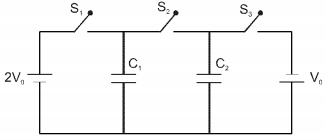
IIT 2013, Medium


Download our appand get started for free
Experience the future of education. Simply download our apps or reach out to us for more information. Let's shape the future of learning together!No signup needed.*
Similar Questions
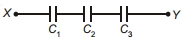
- 1In the circuit below $C_1=20 \,\mu F , C_2=40 \,\mu F$ and $C_3=50 \,\mu F$. If no capacitor can sustain more than $50 \,V$, then maximum potential difference between $X$ and $Y$ is .......... $V$View Solution
- 2After the switch shown in figure $A$ is closed, there is current $i$ through resistance $R$. Figure $B$ indicates current variation curves $a, b, c$ and $d$ for four sets of values of $R$ and capacitance $C$:View Solution
$(i)$ $R_0$ and $C_0$, $(ii)$ $2R_0$ and $C_0$,
$(iii)$ $R_0$ and $2C_0$, $(iv)$ $2R_0$ and $2C_0$.
Which set goes with which curve?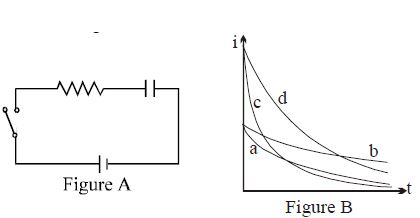
- 3Two parallel plate capacitor with different plate seperation but the same capacitance are connected in series to a battery. Both capacitors are filled with air. The quantity that is $NOT$ the same for both the capacitors when they are fully charged isView Solution
- 4How much work is required to carry a $6$ $\mu C$ charge from the negative terminal to the positive terminal of a $9\, V$ batteryView Solution
- 5A $5\, \mu F$ capacitor is charged fully by a $220\,V$ supply. It is then disconnected from the supply and is connected in series to another uncharged $2.5\;\mu F$ capacitor. If the energy change during the charge redistribution is $\frac{ X }{100} \;J$ then value of $X$ to the nearest integer is$.....$View Solution
- 6A capacitor of $20\,\mu F$ is charged to $500\;volts$ and connected in parallel with another capacitor of $10\,\mu F$ and charged to $200\;volts$. The common potential is.......$volts$View Solution
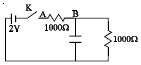
- 7In the circuit shown, when the key $k $ is pressed at time $t = 0$, which of the following statements about current $I$ in the resistor $AB $ is trueView Solution
- 8In order to obtain a time constant of $10$ seconds in an $RC$ circuit containing a resistance of $10^3\,\Omega,$ the capacity of a condenser should be.....$ \mu F$View Solution
- 9The distance between the plates of a parallel plate condenser is $\,4mm$ and potential difference is $60\;volts$. If the distance between the plates is increased to $12\,mm$, thenView Solution
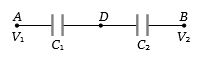
- 10Two condensers ${C_1}$and ${C_2}$ in a circuit are joined as shown in figure. The potential of point $A$ is ${V_1}$ and that of $B$ is ${V_2}$. The potential of point $D$ will beView Solution