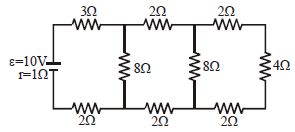
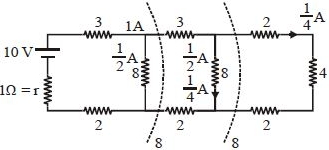
In the circuit shown, the cell has $emf = 10\,V$ and internal resistance $= 1\, \Omega$ :-
Diffcult


Download our appand get started for free
Experience the future of education. Simply download our apps or reach out to us for more information. Let's shape the future of learning together!No signup needed.*
Similar Questions
- 1An ideal gas mixture filled inside a balloon expands according to the relation $PV^{2/3} =$ constant. The temperature inside the balloon isView Solution
- 2The length of a wire of a potentiometer is $100\, cm$, and the $emf$ of its standard cell is $E\,volt$. It is employed to measure the $e.m.f$ of a battery whose internal resistance is $0.5 \,\Omega$. If the balance point is obtained at $l = 30\, cm$ from the positive end, the $e.m.f.$ of the battery isView Solution
where $i$ is the current in the potentiometer
- 3The maximum power drawn out of the cell from a source is given by (where $r$ is internal resistance)View Solution
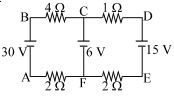
- 4View SolutionThe figure shows a network of four resistances and three batteries Which of the battery is getting charged.
- 5A current of $2\, A$ passing through conductor produces $80\, J$ of heat in $10$ seconds. The resistance of the conductor is ............ $\Omega$View Solution
- 6A strip of copper and another of germanium are cooled from room temperature to $80\, K$. The resistance ofView Solution
- 7Three bulbs of $40\,W$, $60\,W$ and $100\,W$ are arranged in series with $220\,V$. Which bulb has minimum resistance............... $W$View Solution
- 8If $2.2\,kW$ power is transmitted through a $100\,\Omega $ line at $22,000\,V,$ the power loss in the form of heat will be ............. $W$View Solution
- 9When current supplied by a cell to a circuit is $0.3 \,A$, its terminal potential difference is $0.9 \,V$. When the current supplied becomes $0.25 \,A$, its terminal potential difference becomes $1.0 \,V$. The internal resistance of the cell is ............ $\Omega$View Solution
- 10When connected across the terminals of a cell, a voltmeter measures $5\,V$ and a connected ammeter measures $10\, A$ of current. A resistance of $2\, ohms$ is connected across the terminals of the cell. The current flowing through this resistance will be ............ $A$View Solution