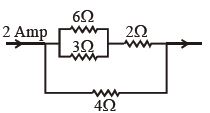
When current supplied by a cell to a circuit is $0.3 \,A$, its terminal potential difference is $0.9 \,V$. When the current supplied becomes $0.25 \,A$, its terminal potential difference becomes $1.0 \,V$. The internal resistance of the cell is ............ $\Omega$
Easy


Download our appand get started for free
Experience the future of education. Simply download our apps or reach out to us for more information. Let's shape the future of learning together!No signup needed.*
Similar Questions
- 1In a potentiometer arrangement. $E_1$ is the cell establishing current in primary circuit. $E_2$ is the cell to be measured. $AB$ is the potentiometer wire and $G$ is a galvanometer. Which of the following are the essential condition for balance to be obtained.View Solution
- 2A wire has a resistance of $6 \,\Omega$. It is cut into two parts and both half values are connected in parallel. The new resistance is ................ $\Omega$View Solution
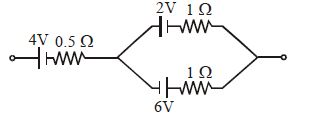
- 3Find the net emf of the three batteries shown in figure ................ $\mathrm{V}$View Solution
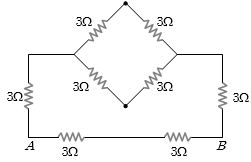
- 4Equivalent resistance between $A$ and $B$ will be ............ $ohm$View Solution
- 5A meta sample carrying a current along $x-$ axis with density $J$ is subjected to a magnetic field $B$ (along $z-$ axis). The electric field $E$ developed along $y-$ axis is directly proportional to $J$ as well as $B$. The constant of proportionality has $SI\ unit$View Solution
- 6A rectangular parallelopiped is measured as $1\,cm \times 1\,cm \times 100\,cm$. If its specific resistance is $3 \times 10^{-7}\,\Omega\,m$, then the resistance between its two opposite rectangular faces will be $..........x^{-7} \Omega$.View Solution
- 7A cell of e.m.f. $E$ is connected with an external resistance $R$, then p.d. across cell is $V$. The internal resistance of cell will beView Solution
- 8A wire of length $100\, cm$ is connected to a cell of $emf$ $2\, V$ and negligible internal resistance. The resistance of the wire is $3\, \,\Omega$. The additional resistance required to produce a potential drop of $1$ milli volt per cm is ............... $\Omega $View Solution
- 9Three equal resistors connected in series across a source of $e.m.f.$ together dissipate $10\, watt$. If the same resistors are connected in parallel across the same $e.m.f.$, then the power dissipated will be .............. $watt$View Solution
- 10In the adjoining circuit, the potential difference across $3\,\,\Omega $ is ................ $\mathrm{V}$View Solution