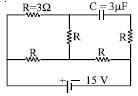
In the circuit shown, the cell is ideal, with $emf$ $=$ $15$ $V$. Each resistance is of $3 $ $\Omega$ . The potential difference across the capacitor is.....$V$
Advanced
Download our app for free and get started
As a fully charged capacitor draws no current so no current flow through resistor on right The current flow through remaining resistors as shown in figure.
Applying Kirchhoff's law
For loop $ABEFGA:$ $R i_{1}+R\left(i_{1}+i_{2}\right)=15$
$\Longrightarrow 2 i_{1}+i_{2}=\frac{15}{R}=\frac{15}{3}=5 \ldots .(1)$
For loop $ABCDEFGA:$ $R i_{2}+R i_{2}+R\left(i_{1}+i_{2}\right)=15$
$\Longrightarrow i_{1}+3 i_{2}=\frac{15}{R}=\frac{15}{3}=5 \ldots . .(2)$
From $(1)$ and $( 2 ):$
$i_{1}+3\left(5-2 i_{1}\right)=5$
$\Rightarrow 5 i_{1}=10$
$\Rightarrow i_{1}=2 A$
Putting, $i_{1}=2$ in $(1)$
$\Rightarrow i_{2}=5-2(2)=1 A$
Thus, Potential across capacitor is: $V_{c}=R i_{2}+R\left(i_{1}+i_{2}\right)=(3 \times 1)+3(2+1)=3+$
$9=12 V$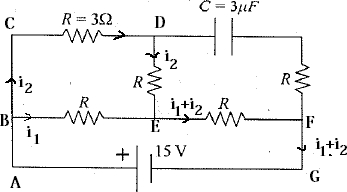

Download our appand get started for free
Experience the future of education. Simply download our apps or reach out to us for more information. Let's shape the future of learning together!No signup needed.*
Similar Questions
- 1Given below are two statements:View Solution
Statement $I$ : A uniform wire of resistance $80\,\Omega$ is cut into four equal parts. These parts are now connected in parallel. The equivalent resistance of the combination will be $5\,\Omega$.
Statement $II :$ Two resistance $2\,R$ and $3\,R$ are connected in parallel in a electric circuit. The value of thermal energy developed in $3\,R$ and $2\,R$ will be in the ratio $3:2.$
In the light of the above statements, choose the most appropriate answer from the options given below
- 2View SolutionThe arrangement as shown in figure is called as
- 3In a meter bridge experiment the balance point in obtained if the gaps are closed by $2\,\Omega$ and $3\,\Omega$. A shunt of $x\,\Omega$ is added to $3\,\Omega$ resistor to shift the balancing point by $22.5\,cm$. The value of $X$ is $................$View Solution
- 4When the power delivered by a $100\,volt$ battery is $40\,watts$ the equivalent resistance of the circuit is ........... $ohms$View Solution
- 5A current of $10\, A$ exists in a wire of crosssectional area of $5\, mm ^{2}$ with a drift velocity of $2 \times 10^{-3}\, ms ^{-1}$. The number of free electrons in each cubic meter of the wire is ..........View Solution
- 6The internal resistance of a $2.1\, V$ cell which gives a current of $0.2\, A$ through a resistance of $10\,\Omega$ is ............. $\Omega$View Solution
- 7A $10\,m$ long potentiometer wire has a potential gradient of $0.0025\, V/cm$. Calculate the distance of null point when the wire is connected to a $1.025\,V$ standard cell ............... $\mathrm{m}$View Solution
- 8The potential difference between points $A$ and $B$ of adjoining figure isView Solution
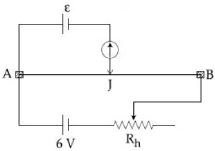
- 9The resistance of the meter bridge $AB$ in given figure is $4\,\Omega $. With a cell of emf $\varepsilon \, = 0.5\,\,V$ and rheostat resistance $R_h = 2\,\Omega $ the null point is obtained at some point $J.$ When the cell is replaced by another one of emf $\varepsilon \, = {\varepsilon _2}$ the same null point $J$ is found for $R_h = 6\,\Omega .$ The $emf$ ${\varepsilon _2}$ is ................. $V$View Solution
- 10If two electric bulbs have $40\, W$ and $60\, W$ rating at $220\, V$, then the ratio of their resistances will beView Solution