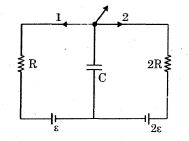
In the circuit shown, the switch is shifted from position $1 \rightarrow 2$ at $t = 0$. The switch was initially in position $1$ since a long time. The graph between charge on capacitor $C$ and time $'t'$ is
Medium
Download our app for free and get started
At $t = 0$, the charge on cap acitor is $Q_0 = CE$ After a long time, the charge on cap acitor will be $2Q_0 = 2CE$ :. graph is $(2)$

Download our appand get started for free
Experience the future of education. Simply download our apps or reach out to us for more information. Let's shape the future of learning together!No signup needed.*
Similar Questions
- 1The potential function of an electrostatic field is given by $V = 2x^2$. Determine the electric field strength at the point $(2\,m, 0, 3\,m)$View Solution
- 2A capacitor of capacity ${C_1}$ is charged upto $V$ volt and then connected to an uncharged capacitor of capacity ${C_2}$. Then final potential difference across each will beView Solution
- 3View SolutionThe outer sphere of a spherical air capacitor is earthed. For increasing its capacitance
- 4Two capacitors of capacitances $3\,\mu \,F$ and $6\,\mu F$ are charged to a potential of $12 \,V$ each. They are now connected to each other, with the positive plate of each joined to the negative plate of the other. The potential difference across each will be......$volt$View Solution
- 5The capacity of a parallel plate condenser is $10\,\mu F$ without dielectric. Dielectric of constant $2$ is used to fill half the distance between the plates, the new capacitance in $\mu F$ isView Solution
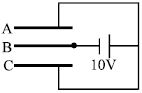
- 6Three plates $A, B$ and $C$ each of area $0.1 \ m^2$ are separated by $0.885\ mm$ from each other as shown in the figure. $A$ $10$ $V$ battery is used to charge the system. The energy stored in the system isView Solution
- 7In order to obtain a time constant of $10$ seconds in an $RC$ circuit containing a resistance of $10^3\,\Omega,$ the capacity of a condenser should be.....$ \mu F$View Solution
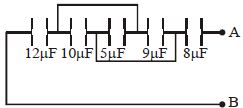
- 8Five capacitors together with their capacitances are shown in the adjoining figure. The potential difference between the points $A$ and $B$ is $60\, volt.$ The equivalent capacitance between the point $A$ and $B$ and charge on capacitor $5\,\mu F$ will be respectively :-View Solution
- 9Two identical electric point dipoles have dipole moments $\overrightarrow{p}_{1}= p\hat i$ and $\overrightarrow{p}_{2}=- p\hat i$ and are held on the $x-$axis at distance $'a'$ from each other. When released, they move along the $x-$axis with the direction of their dipole moments remaining unchanged. If the mass of each dipole is $'m',$ their speed when they arc infinitely far apart isView Solution
- 10A charge of $8\; mC$ is located at the origin. Calculate the work done in $J$ in taking a small charge of $-2 \times 10^{-9} \;C$ from a point $P (0,0,3\; cm )$ to a point $Q (0,4\; cm , 0),$ via a point $R (0,6\; cm , g \;cm )$View Solution