Question
In the depletion region of a diode:

Answer

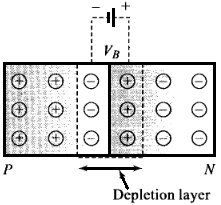
On account of difference in concentration of charge carrier in the two sections of $P-N$ junction, the electrons from $N-$rcgion diffuse through the junction into $P-$region and the hole from $P-$region diffuse into $N-$region.

Due to diffusion, neutrality of both $N-$and $P-$type semiconductor is disturbed, a layer of negative charged ions appear near the junction in the $P-$crystal and a layer of positive ions appears near the junction in $N-$crystal.
This layer is called depletion layer.
The thickness of depletion layer is $1$ micron $= 10^{-6}m.$
Width of depletion layer $\infty 1/$Dopping
Depletion is directly proportional to temperature.
Important point: The $P-N$ junction diode is equivalent to capacitor in which the depletion layer acts as a dielectric.

Need a full question paper?

Generate a complete, print-ready paper with questions like this in minutes — across 16+ boards, with answer keys.
Start Generating Free

Similar questions

A charge of Q coulomb is placed on a solid piece of metal of irregular shape. The charge will distribute itself(a) Uniformly in the metal object(b) Uniformly on the surface of the object(c) Such that the potential energy of the system is minimised(d) Such that the total heat loss is minimised


The state of charge inside a closed surface is changed in such a way that total charge remains constant, the flow of electric flux from the closed surface:
The mass defect per nucleon is called:
If the threshold wavelength for sodium is 5420 Å, then the work function of sodium is(a) 4.58 eV(b) 2.28 eV(c) 1.14 eV(d) 0.23 eV
       
X – rays and γ -  rays of the same energies may be distinguished by(a) Their velocity(b) Their ionising power(c) Their intensity(d) Method of production
   
   
Corpuscular theory of light was advanced by:
The rest energy of an electron is(a) 510 KeV(b) 931 KeV(c) 510 MeV(d) 931 MeV
       
The engine of a train sounds a whistle at frequency v. The frequency heard by a passenger is:
  1. $>\text{v}$
  2. $<\text{v}$
  3. $=\frac{1}{\text{v}}$
  4. $=\text{v}$
With increase in temperature the conductivity of:
A solid sphere moves at a terminal velocity of $20m/s$ in air at a place where $g = 9.8m/s^2$. The sphere is taken in a gravity free hall having air at the same pressure and pushed down at a speed of $20m/s.$
  1. Its initial acceleration will be $9.8m/s^2$ downward.
  2. Its initial acceleration will be $9.8m/s^2$ upward.
  3. The magnitude of acceleration will decrease as the time passes.
  4. It will eventually stop.