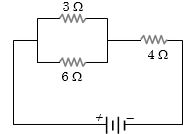
In the figure, current through the $3\,\Omega $ resistor is $0.8\, ampere$, then potential drop through $4\,\Omega $ resistor is ........... $V$
AIPMT 1993, Medium
Download our app for free and get started
Current through $6\,\Omega$ resistance in parallel with $3\,\Omega$ resistance $= 0.4\, A$
So total current $=$ $0.8 + 0.4 = 1.2\, A$
Potential drop across $4\,\Omega = 1.2 \times 4 = 4.8\,V$

Download our appand get started for free
Experience the future of education. Simply download our apps or reach out to us for more information. Let's shape the future of learning together!No signup needed.*
Similar Questions
- 1In an experiment of meter bridge, a null point is obtained at the centre of the bridge wire. When a resistance of $10\, ohm$ is connected in one gap, the value of resistance in other gap is ............. $\Omega$View Solution
- 2An electric bulb is designed to draw power $P_0$ at voltage $V_0$. If the voltage is $V$ it draws a power $P$. ThenView Solution
- 3$n$ identical cells each of $e.m.f.$ $E$ and internal resistance $r$ are connected in series. An external resistance $R$ is connected in series to this combination. The current through $R$ isView Solution
- 4There are $0.8 \times 10^{23}$ free electrons $/ cm^3$ in copper. If $0.2\, A $ current is flowing is copper wire, then the drift velocity of electrons will be, if the cross sectional area of wire is $0.01 \,cm^2$View Solution
- 5View SolutionElectric current has both magnitude and direction. It is a
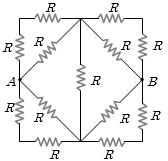
- 6Thirteen resistances each of resistance $R\, ohm$ are connected in the circuit as shown in the figure below. The effective resistance between $A$ and $B$ isView Solution
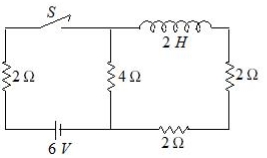
- 7For the given circuit the current through battery of $6\,V$ just after closing the switch ' $S$ ' will be$.......A$.View Solution
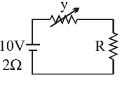
- 8In the figure shown the power generated in $y$ is maximum when $y = 5\,\Omega $. Then $R$ isView Solution
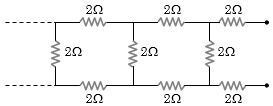
- 9View SolutionThe equivalent resistance of the following infinite network of resistances is
- 10A cell of internal resistance $3\, ohm$ and $emf$ $10\, volt$ is connected to a uniform wire of length $500 \,cm$ and resistance $3\, ohm$. The potential gradient in the wire is .............. $mV/cm$View Solution