The equivalent resistance of the following infinite network of resistances is
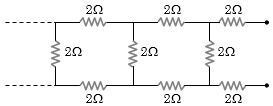
AIIMS 1995, Medium


Download our appand get started for free
Experience the future of education. Simply download our apps or reach out to us for more information. Let's shape the future of learning together!No signup needed.*
Similar Questions
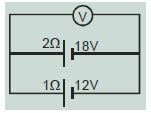
- 1Two batteries, one of $emf$ $18\, volts$ and internal resistance $2\,\Omega $ and the other of $emf$ $12\, volt$ and internal resistance $1\,\Omega $, are connected as shown. The voltmeter $V$ will record a reading of .............. $\mathrm{volt}$View Solution
- 2A heater of $220\, V$ heats a volume of water in $5\,\min$ time. A heater of $110\, V$ heats the same volume of water in ............... $min$View Solution
- 3View SolutionThe material of wire of potentiometer is
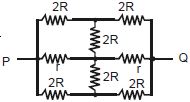
- 4The effective resistance between points $P$ and $Q$ of the electrical circuit shown in the figure isView Solution
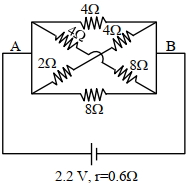
- 5In the given figure, the $emf$ of the cell is $2.2\, {V}$ and if internal resistance is $0.6\, \Omega$. Calculate the power dissipated in the whole circuit: (in $W$)View Solution
- 6A $25\, W$, $ 220\, V$ bulb and a $100\, W$, $220\, V$ bulb are connected in parallel across a $440\, V$ lineView Solution
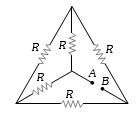
- 7Each of the resistance in the network shown in fig. is equal to $R$. The resistance between the terminals $A$ and $B$ isView Solution
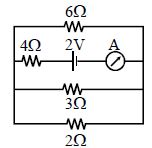
- 8The reading of the ammeter in the adjoining figure will be .............. $A$View Solution
- 9What equal length of an iron wire and a copper-nickel alloy wire, each of $2 \; {mm}$ diameter connected parallel to give an equivalent resistance of $3 \Omega ?$View Solution
(Given resistivities of iron and copper-nickel alloy wire are $12 \;\mu \Omega {cm}$ and $51\; \mu \Omega {cm}$ respectively) (in ${m}$)
- 10View SolutionWhich of the following statement is correct