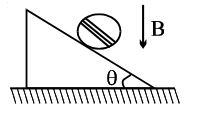
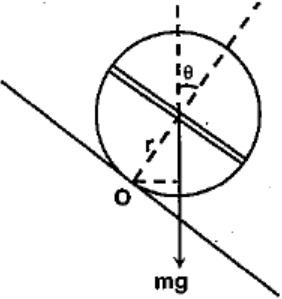
In the figure shown a coil of single turn is wound on a sphere of radius $R$ and mass $m.$ The plane of the coil is parallel to the plane and lies in the equatorial plane of the sphere. Current in the coil is $i$. The value of $B$ if the sphere is in equilibrium is
Diffcult


Download our appand get started for free
Experience the future of education. Simply download our apps or reach out to us for more information. Let's shape the future of learning together!No signup needed.*
Similar Questions
- 1A spherical shell of radius $'R'$ carries uniformly distributed charge $'Q'$ is rotated about it's diameter with angular speed $\omega $ find it's magnetic momentView Solution
- 2Two thin long parallel wires, separated by a distance $d$ carry a current of $I$ $amp$ in the same direction. They willView Solution
- 3View SolutionA charged particle moves through a magnetic field perpendicular to its direction. Then
- 4View SolutionIf a positive ion is moving, away from an observer with same acceleration, then the lines of force of magnetic induction will be
- 5A closely packed coil having $1000$ turns has an average radius of $62.8\,cm$. If current carried by the wire of the coil is $1\,A$, the value of magnetic field produced at the centre of the coil will be (permeability of free space $=4 \pi \times 10^{-7}\,H / m$ ) nearlyView Solution
- 6View SolutionIf cathode rays are projected at right angles to a magnetic field, their trajectory is
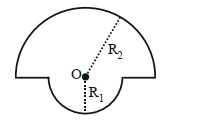
- 7The magnetic field at the centre of a wire loop formed by two semicircular wires of radii $R_1=2 \pi\ \mathrm{m}$ and $R_2=4 \pi\ \mathrm{m}$ carrying current $I=4 \mathrm{~A}$ as per figure given below is $\alpha \times 10^{-7} \mathrm{~T}$. The value of $\alpha$ is___________ (Centre $\mathrm{O}$ is common for all segments)View Solution
- 8A proton of velocity $\left( {3\hat i + 2\hat j} \right)\,ms^{-1}$ enters a magnetic field of $(2\hat j + 3\hat k)\, tesla$. The acceleration produced in the proton is (charge to mass ratio of proton $= 0.96 \times10^8\,Ckg^{-1}$)View Solution
- 9To Verify Ohm's law, a student is provided with a test resistor $\mathrm{R}_{\mathrm{T}}$, a high resistance $\mathrm{R}_1$, a small resistance $\mathrm{R}_2$, two identical galvanometers $\mathrm{G}_1$ and $\mathrm{G}_2$, and a variable voltage source $\mathrm{V}$. The correct circuit to carry out the experiment isView Solution
- 10A particle of charge $q$ and mass $m$ moving with a velocity $v$ along the $x$-axis enters the region $x > 0$ with uniform magnetic field $B$ along the $\hat k$ direction. The particle will penetrate in this region in the $x$-direction upto a distance $d$ equal toView Solution