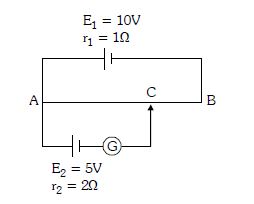
In the figure the potentiometer wire of length $l =100\, cm$ and resistance $9\Omega$ is joined to a cell of emf $E_1 = 10V$ and internal resistance $r_1 = 1\Omega $. Another cell of emf $E_2 = 5\, V$ and internal resistance $r_2 = 2 \Omega $ is connected as shown. The galvanometer $G$ will show no deflection when the length $AC$ is ............... $cm$
Medium


Download our appand get started for free
Experience the future of education. Simply download our apps or reach out to us for more information. Let's shape the future of learning together!No signup needed.*
Similar Questions
- 1A battery of $24$ cells, each of emf $1.5\, V$ and internal resistance $2\, \Omega$ is to be connected in order to send the maximum current through a $12 \,\Omega$ resistor. The correct arrangement of cells will beView Solution
- 2In a meter bridge experiment null point is obtained at $20\, cm$ from one end of the wire when resistance $X$ is balanced against another resistance $Y$. If $X < Y$, then where will be the new position of the null point from the same end, if one decides to balance a resistance of $4X$ against $Y$ ........... $cm$View Solution
- 3A uniform wire of $16\,\Omega $ is made into the form of a square. Two opposite corners of the square are connected by a wire of resistance $16\,\Omega $. The effective resistance between the other two opposite corners is ............... $\Omega$View Solution
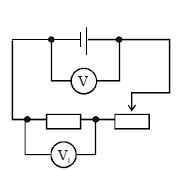
- 4If the rheostat slider were to move from the extreme right to the far left, How will the reading of voltmeter $V_1$ change?View Solution
- 5What is the equivalent resistance of the circuit ............. $\Omega$View Solution
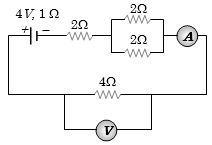
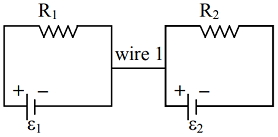
- 6In the circuit, wire $1$ is of negligible resistance. Then,View Solution
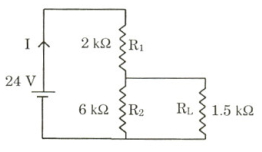
- 7For the circuit shown in the figureView Solution
$(A)$ the current $I$ through the battery is $7.5 \mathrm{~mA}$
$(B)$ the potential difference across $R_{\mathrm{L}}$, is $18 \mathrm{~V}$
$(C)$ ratio of powers dissipated in $R_1$ and $R_2$ is $3$
$(D)$ if $R_1$ and $R_2$ are interchanged, magnitude of the power dissipated in $R_{\mathrm{L}}$ will decrease by a factor of $9$
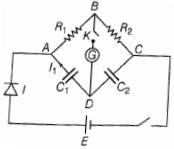
- 8ln the circuit in the figure, if no current flows through the galvanometer when the key $K$ is closed, the bridge is balanced. The balancing condition for bridge isView Solution
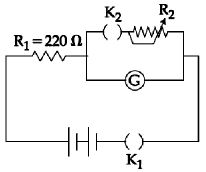
- 9The galvanometer deflection, when key $K_1$ is closed but $K_2$ is open, equals $\theta_0$ (see figure). On closing $K_2$ also and adjusting $R_2$ to $5\,\Omega $ , the deflection in galvanometer becomes $\frac{{\theta _0}}{5}$. The resistance of the galvanometer is, then, given by [Neglect the internal resistance of battery]: .................. $\Omega$View Solution
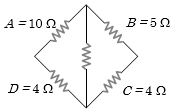
- 10In a typical Wheatstone network, the resistances in cyclic order are $A = 10 \,\Omega $, $B = 5 \,\Omega $, $C = 4 \,\Omega $ and $D = 4 \,\Omega $ for the bridge to be balancedView Solution